Showing posts with label Oscar buzz. Show all posts

Sunday, January 5, 2014

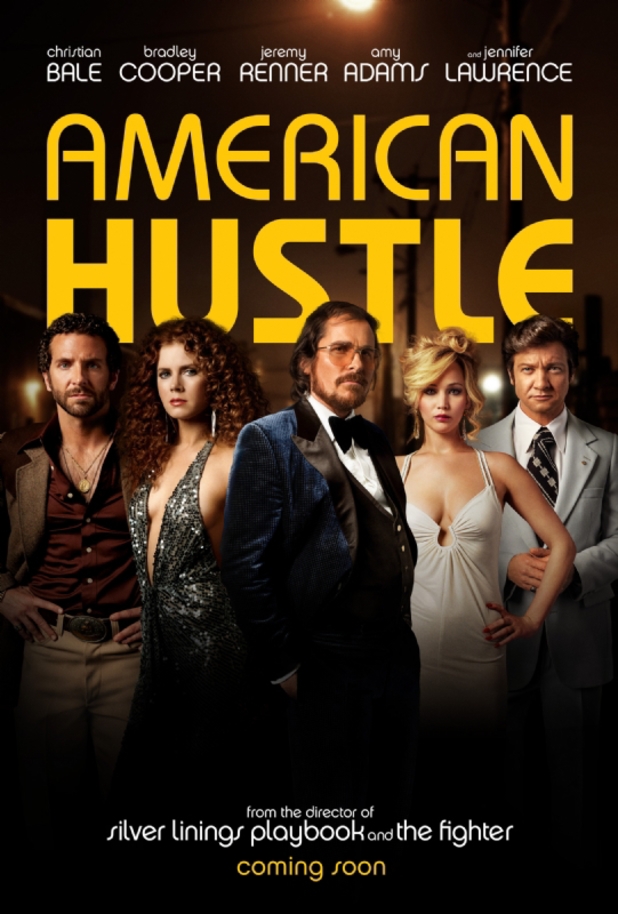
Best of 2013: #10 American Hustle


In the opening scene of American Hustle, Irving Rosenfeld (played by Christian Bale) stands in front of a mirror perfecting an epic comb-over with his hair.  He's meticulous, taking his time, even gluing in some fake hair for good measure.  The scene is hilarious, and it sets the stage perfectly for the rest of the movie.  

Irving is a fraud, just like everyone else in this movie.  

Irving owns a small chain of dry cleaners, but he makes most of his money through phony art deals and personal loan scams.  He's got a wife (played by Jennifer Lawrence) and an adopted son in Long Island, but his heart belongs to his partner in crime Sydney Prosser (played by Amy Adams), another fraud.  

Sydney's an Albuquerque transplant who came to New York dreaming remaking herself as a member of high society.  After meeting Irving and learning about his business model, she decides to don a fake accent and become Lady Edith Greensley, a British aristocrat with London banking connections, believing (correctly) that such an association would help with the fraudulent loans.  

Eventually, they try to scam the wrong guy -- Richie DiMaso (played by Bradley Cooper), an ambitious and delightfully hotheaded FBI agent.  Richie catches them in the act, but proposes that they help him catch other scam artists in return for avoiding jail times.  The result of their combined efforts is the FBI's Abscam operation, a real-life endeavor that eventually eventually lead to the convictions of seven members of Congress for bribery.  The movie, however, is a fiction.  

Richie is also fraud.  He's an underling at the FBI and he concocts this operation and let's it grow in size and complexity, even going around his superiors to do so, as a means of raising his stature.  Like Iriving, he sports a fake hairstyle, putting his hair in curlers every night, which is hilarious, by the way.  Eventually, he falls for Sydney, though he doesn't know she's not British or, for that matter, that her name is Sydney.  This, of course, is part of Sydney's plan, both to keep Richie close and to punish Irving.  And, it works.  Richie is sucked in by her life as a scam artist -- the parties, the dance clubs -- even though he's got a plain fiance stashed away at home. 

In the end, all three lead characters are scamming each other and the movie is a race to see who will scam who last.  The most honest character in the movie is the original target of their operation, Camden, New Jersey Mayor Carmine Polito (played by Jeremy Renner), who, from the outset, takes bribes and offers them to others.  

All of this plays out with a rare kinetic intensity, playing fast and loose as the story unfolds.  Though the plot is detailed and convoluted, the movie feels a little sloppy at times, which is actually a big part of its charm.  This isn't Oceans Eleven or The Sting.  No one in the movie is all that smart no one has an over-arching plan.  Sure, there are scams and double-crosses, but they are made up as they go along.

This on-the-fly construction is the genius of director David O. Russell, who has really come into his own with his last three movies -- The Fighter, Silver Linings Playbook, and, now, American Hustle.  Don't get me wrong, he was great before that, too.  But, with these movies, he's established himself as one of the best mainstream filmmakers around.    

As with Russell's previous films, the acting in this movie is superb across the board.  Adams and Russell give career-best performances, both worthy of Oscar consideration, though, from the looks of things, they're not likely to get it.  Bale is great as always, though, to be honest, it's probably his second best performance of the year, behind Out of the Furnace.  Renner is also very good.

However, the most memorable performance in the movie is that of Jennifer Lawrence, playing Irving's needy, passive-aggressive wife who gets just involved enough in the operation to screw things up.  She's a firecracker, an absolute scene-stealer.  She's destined to receive her third Oscar nomination for this role.  And, as I've said before, she's one step closer to world domination.  

In the end, the movie drags out a bit too long and the final scam is one you should probably see coming if you've seen movies like this before.  But, it never stops being fun and the characters never stop pulling you in.  This is what happens when good filmmakers and great actors get together.  


Monday, December 9, 2013

In Theaters: Nebraska ***1/2


I've written about Alexander Payne -- one of the finest directors working today -- on this blog before.  A couple years back, I wrote a review of his last film The Descendants where I said this:
His movies tend to circulate around less-than-heroic figures, below-average Joes whose troubles are common and familiar and, more often than not, self-inflicted.  Most of his protagonists tend to be middle-aged-men -- or, in the case of About Schmidt, an older-than-middle-aged man -- who are coming to terms with the disappointing lives they've created for themselves.  While this is hardly a unique approach for modern cinematic storytelling, Payne's sincere affection for each of the schlubs he's created, even when they don't deserve it, is always refreshing.  It's easy to create a loser just to make fun of him.  But, that's not how Payne works.  
I reread that as I sat down to write this review and my first thoughts were: 1) I think I'm a better writer than I was back then, and 2) Nebraska is, in many ways, par for the course with Alexander Payne.

The movie tells the story of Woody Grant (played by the magnificent Bruce Dern), an old codger who receives a Publisher's Clearinghouse letter in the mail telling him he's won a million dollars and believes it.  This sets him off on a quixotic quest from Billings, Montana to Lincoln, Nebraska in order to claim his prize.

At first, he tries to walk there, though he doesn't get very far thanks to the police.  So, he has to enlist the help of his son David (played by the surprisingly subtle Will Forte).  David knows it's a scam and suspects his father is suffering from dementia.  But he also recognizes that his dad has little else to live for and, in many respects, neither does he.

On their way to Lincoln, they stop off in Woody's hometown to see his relatives and some of his old friends.  David gets an opportunity to learn about his father's past, which allows him to finally connect with the old man in ways that were never possible in their icy dynamic.  Most of these old acquaintances are quick to believe Woody's story, and some of them want in on the action.  Indeed, at times it seems that only David, his brother Ross (played by Bob Odenkirk), and his mother (played by June Squibb) know what's going on.

Ultimately, Nebraska is both a tribute to small-town America and sort of a comic indictment of some of the people who live there.  It's also a case-study in the friction that so often belies father-son relationships.  It's shot in beautiful black and white, reflecting both the supposed simplicity of the life and values it portrays and the emptiness of the lives of its main characters.

I'm not going to pretend that I know much about Bruce Dern, though I've read a lot about him in relation to this movie.  He's spent a lifetime in supporting roles, usually hamming it up -- as supporting actors often do -- in order to stand out.  But, here he's all cloudy eyes and mumbles, portraying a man broken down by years of hard life and hard living.  It's a slow-burn performance that pays off big time.  He's likely destined for an Oscar nomination.

The supporting cast are all first-rate.  Like I said, Forte shows all new levels of depth that you just wouldn't suspect after his years on SNL.  And, June Squibb is simply outstanding.  She steals every scene that she's in.

All told, Nebraska is a worthy entry into the canon of Alexander Payne.  It is, in my opinion, one of the best movies of the year.


Monday, November 25, 2013

In Theaters: All is Lost ****


One man, adrift for eight days on the Indian Ocean.

In a nutshell, that's what director J.C. Chandor's brilliant new film All is Lost is about.  Sure, there are details, but, to be honest, there aren't that many.  The main character doesn't even have a name -- he's credited as "Our Man."  There's no backstory, no explanation as to why he's on his boat in the first place, and, other than a few lines here and there, there's not really any dialogue.

I know it sounds like a bore, but it's not.  In fact, All is Lost is one of the most riveting and emotional movies you'll ever see.  The fact that it succeeds is a testament mostly to the ability of its leading man, Robert Redford, who brings to the role every bit of his trademark charisma and star power, along with a whole bunch of stuff we've rarely seen from him before.

The movie opens when Our Man's sailboat, the "Virginia Jean," collides with a floating shipping container, leaving a gaping whole in the side and disabling his navigation and communication equipment.  This sets off a chain of events wherein the man does everything he can to save his boat and then himself, all the time displaying the cool competence of an able seaman.  

Like I said, there are no other characters and Our Man doesn't stop to explain what he's doing out loud.  But, because the movie is so well shot and acted, the audience is never confused or at loss, we are engaged every step of the way.

Once again, I can't say enough about Redford's performance in this film.  He's always been more of a "movie star" than an "actor."  But, with this film, he is both at the same time.  He's spent over four decades building a relationship with movie-going audiences, which means that no backstory is necessary to make us root for him from the outset.  However, getting us on board is only half the battle -- he's also got to keep us there, all without playing off of other actors or even the benefit of dialogue.

He accomplishes this feat with a subtle, nuanced performance, conveying wit and intelligence without overplaying a thing.  By the time the film is over, the audience is mesmerized, following every movement and mannerism.  He will almost certainly be nominated for an Oscar...and he just might win.

Chandor's technical prowess behind the camera should also be praised.  I was not one those who went gaga over his directorial debut, Margin Call a few years back.  It was fine, it just didn't resonate all that much with me.  But, between that film and All is Lost, we may be witnessing the emergence of one of the most eclectic and versatile directors working today.  I am, no pun intended, completely on board to see whatever Chandor does next.

In short, this is a marvelous film.  One of the best of the year.  


Wednesday, December 26, 2012

In Theaters: Lincoln ****


Lincoln is a movie a long time in the making.

For over a decade, Steven Spielberg had been talking about making an Abraham Lincoln biopic based on the Doris Kearns Goodwin's seminal Lincoln biography, Team of Rivals.  For one reason or another, the project never got moving until last year.

Now, when you're making a movie about a renowned historical figure, casting the lead is the first and probably the most important decision.  And, last year, when it was announced that Daniel Day-Lewis would take on the role in this incarnation of our 16th President, it was clear that Spielberg had hit that first ball out of the park.

But, once that first decision is made, there are, as with all movies, countless other decisions that can impact the success or failure of the enterprise.  With Spielberg at the helm, this particular movie was fraught with peril.

Sunday, December 16, 2012

In Theaters: Flight *** and The Sessions ***


So, yeah, I'm combining two reviews in a single blog post.  I've been hoping to avoid posting capsule-style reviews and to keep writing longer reviews of the movies I see.  However, at the current moment, I'm about six or seven movies behind in my reviews (not including those for movies I've watched on DVD or Netflix).  This is the only way I can think of to catch up.

That said, I've combined these two movies -- Flight and The Sessions into a single post because, in my mind, they are very similar.  While the stories and the style of film-making couldn't be any more different, both of these movies have the same strength and suffer from pretty much the same weakness.  

To sum it up: Both Flight and The Sessions are three-star movies anchored by four-star performances by their leading men.  


Flight tells the story of Whip Whitaker -- played by Denzel Washington -- an airline pilot with a drinking problem.  It opens with a harrowing depiction of an emergency plane landing wherein Whip miraculously and heroically lands the plane with minimal casualties despite almost a total loss of control.  

That sequence is among the most thrilling you'll see at the movies all year long.  If you've seen the previews, you know how it's going to turn out.  Still, I was captivated and my heart was pounding as I watched it unfold.  Sadly, I was never as interested in the rest of the movie as I was in the opening moments.  

After the crash landing, Whip becomes a hero in the press and in the public.  Of course, those heaping praise and accolades onto Whip don't know he was drunk at the time.  The main storyline of the film deals with Whip's efforts to work with his lawyer (Don Cheadle) and union rep (Bruce Greenwood) to cover up the fact that he had been drinking before and during the flight.  

But, for the most part, that story is in the background.  Flight  is basically a character study of an alcoholic.  And, in depicting the physical and psychological symptoms of Whip's disease, Washington gives one of his finest performances in years.  

Denzel always has a way of classing up and giving credibility to every movie that he's in, even if that movie happens to be ridiculous.  But, without fail, his best, most memorable performances come when he's playing sinners instead of saints and Flight is no exception.  Book it: Denzel will be nominated for yet another Oscar for this performance.  

The problem with the movie is that it doesn't delve very deep into Whip's character.  He is a man dealing with demons that are only hinted at in the story.  We see the physical manifestations of Whip's alcoholism and we get a glimpse as to what it does to his personal relationships.  But, the movie only hints at the backstory.  

Don't get me wrong, a backstory isn't necessary for a movie like this to work.  In fact, the movie does work on most levels.  But, at the heart of the movie is this one character and the script just doesn't give enough depth to that character to make it fully compelling.

These shortcomings don't make it a bad movie, they just keep it from being a great one, and, given that it was director Robert Zemekis's first live-action movie in years,  I really hoped it would be great.  Still, it's a solid piece of work and worth your time.  


The Sessions tells the true story of Mark O'Brien -- played by John Hawkes -- a poet and journalist who was struck with polio at a young age, forcing him to live the majority of his life in an iron lung.  While doing research for an article about the sexual habits of disabled people, Mark decides that he wants to lose his virginity.

He enlists the help of a sex surrogate -- played by Helen Hunt -- who provides such services legally on a therapeutic basis.  But, because he is a devout Catholic, he only does so after getting the go ahead from his priest -- played by William H. Macy.

Hawkes is simply outstanding in the leading role.  As with Flight, the entire success of The Sessions hangs on the top-line performance and, for the most part, he hits it out of the park.  His role is among the more physically demanding that you will ever see and, in most other years, he'd be a shoe-in to win the Best Actor Oscar.

This is great to see because Hawkes has been around for a long time and has become one of the go-to character actors in Hollywood.  It's good to see him this kind of attention for his talents.

The supporting cast is also very good in the film.  Helen Hunt appears to be headed toward a Best Supporting Actress nomination for her role as the sex surrogate, which will also be well-deserved.  Though I do have to say that, while I hate to sound like a prude, she was naked for far too much of the film. William H. Macy has been getting some justified Oscar buzz as well.

As you might expect, given that I've coupled these two reviews, The Sessions suffers from the same near-fatal flaw as Flight.  While the early scenes of the film begin to uncover the inner workings of the main character -- his loneliness and occasional despair, particularly when his condition has shut him out of a fundamental part of the human experience.

There's a sequence in the film depicting Mark's relationship with one of his former assistants.  They become the best of friends and, eventually, he tells her he's in love with her only to be rebuffed in his affections.  This is the only real moment where we get a sense of how emotionally painful and difficult his condition can be.  But, for the rest of the movie, this element is ignored in favor of a focus on the physical limitations of his disease and awkwardness of his first sexual encounters.

So, while you feel for O'Brien and are sad for his plight, there are precious few scenes wherein you get a sense how this has all affected him.  And, once again, this wouldn't necessarily be a bad thing if not for the fact that the movie relies almost entirely on your sympathy for the lead character.  

Like I said, Hawkes is great in the movie.  But, there really isn't a big emotional moment for his character in the story.  There's no Oscar-clip moment for him that I can recall.  I walked out of the movie missing that moment and wishing that it had been there.

Still, the movie works, so long as you're not entirely turned off by the subject matter.