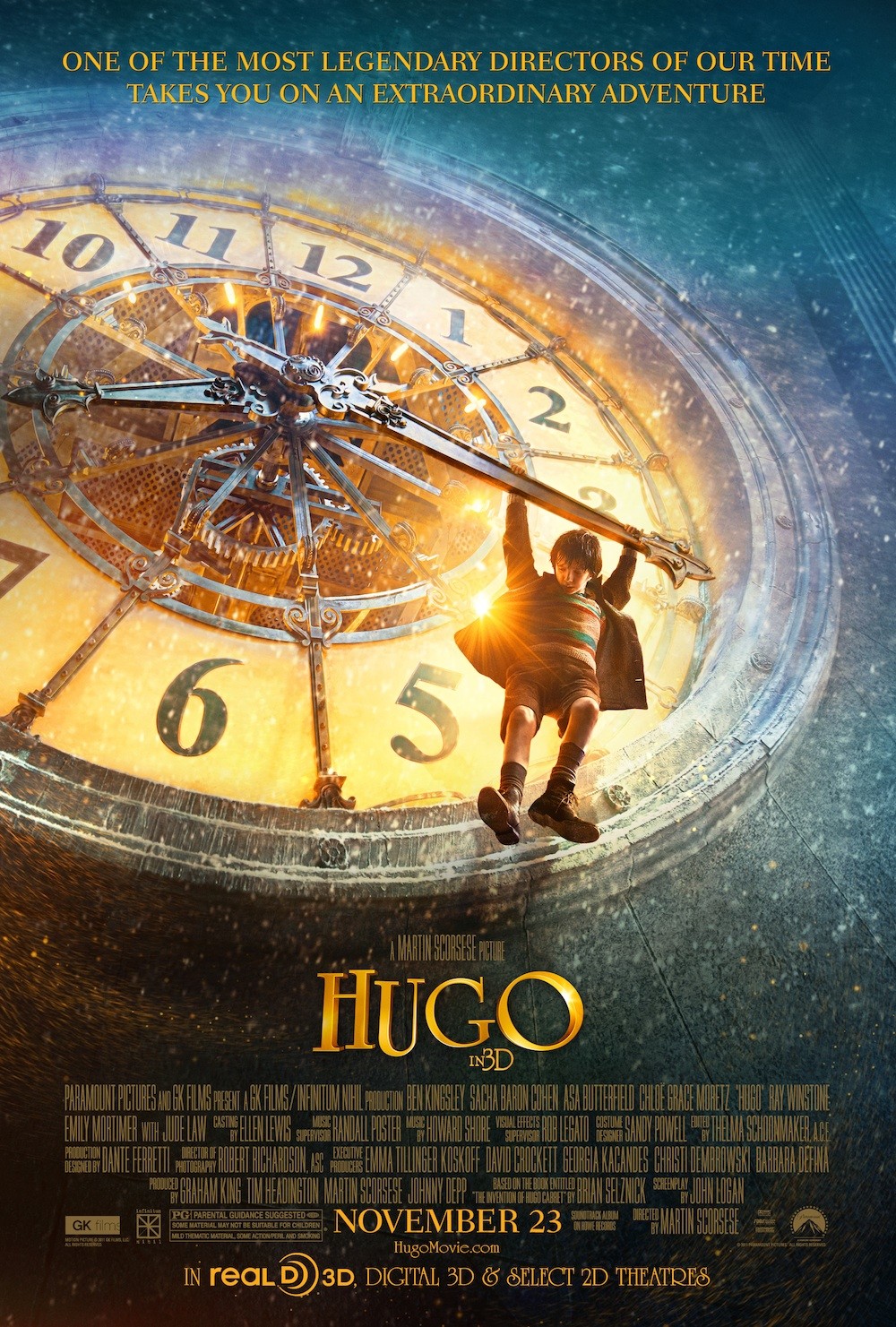
Most people I know that have either seen or heard about Hugo have come away wondering why on Earth Martin Scorsese decided to make this movie. There are no gangsters in the movie, there's very little violence, and it has no good roles for Robert DeNiro or Leonardo DiCaprio. But, when you realize that one of Scorsese's personal passions in the preservation of old movies, particularly silent films, it makes perfect sense.
At it's heart, Hugo is Martin Scorsese's love letter to the cinema. It just takes a little while to get there.
The movie begins by telling the story of one Hugo Cabret (Asa Butterfield) a young boy who lives mysteriously behind the walls of a Paris train station. In addition to working to keep all the station's clocks running on time, Hugo constantly works to stay one step ahead of the station's policeman (Sacha Baron Cohen), who has a knack for rounding up orphans.
In flashbacks, we learn that Hugo's father (Jude Law) taught him how to work with mechanical devices. Their main project was to restore a mysterious automaton to working order. Sadly, his father was killed in a museum fire before they could finish it, forcing Hugo to live with his drunken uncle, the one whose real job it is to maintain the clocks at the train station. In true Dickensian fashion, Hugo is abandoned at the station and, in order to keep from being discovered, decides to take over his uncle's job.
In the meantime, Hugo continues his efforts to restore the automaton, convinced that the machine will reveal a final message from his dead father. And, from the fantastic and magical tone of the first half of the movie, you have to assume that he's correct.
This is the source of the only complaint I've heard from anyone who saw this movie. If you saw the trailers, you might have expected the story of Hugo to involve actual magic and set the boy on a mystical quest to uncover his father's message. And, like I said, the first half of the movie seems to be heading in that direction. The fact that it takes a turn disappointed some...but those people should go write their own movie and stop complaining because the second half of the movie is simply brilliant.
Early in the movie, Hugo befriends Isabelle (Chloe Grace Moretz), a young girl raised by a old man who owns a toy shop at the train station (Ben Kingsley). Eventually, it is revealed that Isabelle and the old man have a connection to the automaton. The mechanical man actually once belonged to the old toy maker...and the old toy maker was once a renowned magician and filmmaker.
It is at this point that the story of Hugo begins to overlap with the true story of Georges Melies, one of the greatest cinematic pioneers of the early 20th Century. Melies made hundreds of movies and was credited by many to be the inventor of special effects. But, between the efforts of Thomas Edison and others to control and monopolize the film industry and the outbreak of World War I, he eventually fell off the map and, just as Hugo depicts him, he eventually became just a poor owner of an unsuccessful toy shop in a Paris train station.
Scholars eventually rediscovered his films and worked to give him credit and recover what was left of the prints. This effort is fictionalized in the second half of Hugo. The audience is treated to wonderful recreations of Melies early films and, through a number of connections and coincidences, Hugo is able to show Georges that his work has not been forgotten.
The story itself would have been enough to warm the hearts of holiday season movie audiences, but it is the look of the movie -- the art direction, special effects, and cinematography -- that will immortalize Hugo in the pantheon of Scorsese classics.
For the most part, 3-D movies are little more than a gimmick to allow theaters to charge moviegoers an extra couple bucks. They rarely serve any real purpose other than that. But, with Hugo, we see that the medium can have a real impact in the hands of a master filmmaker. Scorsese makes great use of the technology to enhance the experience, to put audience in the middle of this alternative version Paris. The experience of seeing Hugo in 3-D gives me a little trepidation about seeing the movie at home on my non-3-D TV. What if it's not any good in 2-D?
Anyway, what Hugo does more than anything else is demonstrate that great filmmakers don't have to rely on genre conventions and go-to moves. Martin Scorsese doesn't appear to be stretching or trying something new...he's as at home adapting a story from a children's book as he is making Goodfellas. It must suck for other less talented filmmakers to have to watch him make such seismic shifts in style, tone, and genre look like second nature. But, if you're in the audience, you certainly can't complain.

Thank you for acknowledging my viewpoint, even if you did do it in a mocking way. By the way, I am writing my own movie. I'll make sure it has a less deceptive trailer.
ReplyDeleteI loved "Hugo". I was even more enthralled to see that the plot involved George Melies. His film "A Trip To The Moon" is a staple of film studies classes, and it's always fun to watch. The imagination he put into his films made them very entertaining, and you can tell he was passionate about his craft. The same can be said for Scorsese, which is why this film works so well. I was actually glad that it didn't resort to wands and pixie dust.
ReplyDeleteAnd I have to make a second comment about the cinematography. I haven't seen this handsome of a film in quite some time. If you love film or film history, this is a winner. If you love fart jokes, explosions or people getting hit in the crotch, not so much.
ReplyDelete