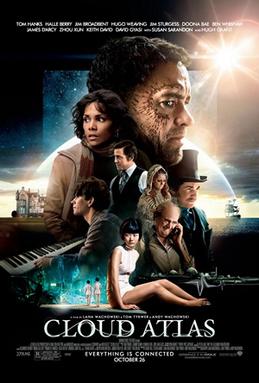
It's kind of strange writing this blog post about Cloud Atlas weeks after seeing the movie. Though I saw it during the opening weekend, I'm now aware that it bombed at the box office and that critical reviews were pretty mixed. In other words, opinions about the movie have been set and I'm unlikely to change anyone's mind about seeing it.
Still, the more I think about Cloud Atlas, the more I admire it. More importantly, the more I think about it, the more I like it.
This is, to put it mildly, an ambitious piece of work. From the minute I saw the first trailer, I said that it was either going to be a masterpiece or a total train wreck. I may have been off by a little -- While I'm not ready to call it a masterpiece, I will say that it works, it works very well.
Where to begin?
Cloud Atlas contains six separate storylines, all of which are connected. The stories are connected literally -- elements of the individual stories impact those that take place later -- but, more than anything, they're connected thematically. They unfold one on top of the other with scenes intermixed throughout and actors are recycled from one story to another, playing different characters each time around. More on that in a minute.
It would take forever to outline each individual plot, so I'll sum them each up in a sentence or two:
- 1849 -- A young lawyer sailing through the South Pacific encounters both sickness and an escaped slave asking for help in securing his freedom.
- 1936 -- A young gay musician composes a masterpiece, but a more famous composer, seeking credit for the work, threatens to expose his scandalous lifestyle.
- 1973 -- An investigative journalist seeks expose a plot by Big Oil to sabotage a nuclear reactor and, along the way, has to escape a hit man hired by an oil company to take her out.
- Present Day -- An old editor, trapped in a nursing home, plots his escape.
- 2144 -- A genetically engineered human escapes from her life of servitude and sparks a revolution.
- 2426 -- A tribesman in a post-apocalyptic Hawaii guides an emissary from a more advanced society through rough terrain to an outpost left behind by humans that left the planet long before.
Though each of these stories is completely unique, they each convey similar themes. Ideas like the importance of love and selflessness are explored in each, but the most repeated and focused theme is the universal nature of mankind's thirst for freedom from captivity. That captivity takes many forms, from the most literal (slavery) to the almost abstract (American addiction to oil), but it is ever-present throughout the film. The point is that these themes continue to play out throughout history and into the future, or, in other words, that history repeats itself.
As I mentioned, this point is reinforced by using the same actors in different roles. For example, Tom Hanks plays (in the order listed above): 1) a doctor slowly poisoning the young lawyer; 2) a hotel manager who blackmails the young composer; 3) a nuclear physicist that betrays his employer out of love; 4) a violent British gangster/author; 5) an actor in a film depicting an earlier storyline; and 5) the tribesman.
Halle Berry, Jim Broadbent, and Jim Sturgess and others also show up in multiple roles, sometimes playing different races -- Berry plays a Jewish woman in one storyline, while Sturgess plays a Korean in another. Sometimes the transformation works, sometimes it doesn't -- the makeup and the accents aren't always spot on. But, in the end, it's never a distraction for more than a scene or two.
Some have suggested that the actors are really playing reincarnated spirits, but I don't think that's the case. There are really no parallels between the multiple characters any actor plays in the film -- sometimes they're sympathetic and other times they're the bad guys. Okay, that's not true -- Hugh Grant and Hugo Weaving are always bad guys. Grant, at one point, is the leader of a cannibal tribe, while Weaving plays both a hallucination representing the devil and a Nurse Ratchet sort of character.
Anyway, like I said, I don't think that the connections between the different characters are supposed to be parallel or literal. Instead, I think the actors' recurring presence suggests a more general interconnectedness between all the stories. Indeed, that's sort of the overall point of the the various plotlines -- the connection is more general and thematic than specific.
At this point I'm probably making the movie sound like a pretentious mess, but it's not. Instead, this is a very accessible piece of work. Like I said, the themes aren't complicated and they're hardly original. They are, instead, among the most common themes in all forms of narrative art. And, the ideas and connections aren't buried in the subtext. If anything, the movie is a little guilty of wearing it's heart a little too much on its sleeve.
Admittedly, there are times where the movie seems destined to devolve into an indecipherable mess. However, the film is very well edited and paced. For the most part, things move along at just the right speed and each element of each story is given the right amount of attention. For the most part.
In the end, it comes together efficiently, with each storyline getting an earned emotional payoff. Even if none of the stories worked -- which they do -- the technical prowess displayed in putting them together so well -- not to mention the incredible visuals that set each storyline apart -- would be worth the price of admission.
The filmmakers whose prowess is display are Lana and Andy Wachowski (the minds behind The Matrix) and Tom Tykwer (Run Lola Run), all three of whom have director credits. For the Wachowskis, this is easily their best work since the original Matrix movie. After a series of misfires, they are completely on top of their game with Cloud Atlas.
Ultimately, I understand why this movie hasn't worked for everyone. It may be too much, too over-the-top for some. Others may not like to have emotional themes spelled out for them. And, of course, some people just can't sit through three hours of any movie.
All I can say is that it worked for me. Indeed, Cloud Atlas will quite likely find its way into my top 10 list for 2012.

No comments:
Post a Comment