Okay...so...here's the thing: I'm tired, lazy, and a little busy. But, at the same time, I REALLY want to get through my posts the Top 10 movies of 2013.
As luck would have it, my Number Nine choice, Nebraska, is a movie I've already reviewed here on the blog. My hope was to write an all new post. However, did I mention that I was tired, lazy, and a little busy at the moment?
There's a lot more I could say about this movie that I didn't cover in my original review. For example, I could write some more about what a great director Alexander Payne is. I could say something about how it this movie isn't just a beautiful tribute to small town America, but a larger examination of America as a whole. I could mention that it also wonderfully examines deeper themes, like loss and regret. Most of all, I could talk about how this movie burrowed its way deep into my mind and continued to haunt me for days after I saw it.
Yeah...I could totally go into all of that. But, I'm not going to. Instead, I'm going to give you a link to my earlier review and hope that you give it a read.
Sorry, dear readers. I'll try not to do this with any other entries on my Top 10.
I've written about Alexander Payne -- one of the finest directors working today -- on this blog before. A couple years back, I wrote a review of his last film The Descendants where I said this:
His movies tend to circulate around less-than-heroic figures, below-average Joes whose troubles are common and familiar and, more often than not, self-inflicted. Most of his protagonists tend to be middle-aged-men -- or, in the case of About Schmidt, an older-than-middle-aged man -- who are coming to terms with the disappointing lives they've created for themselves. While this is hardly a unique approach for modern cinematic storytelling, Payne's sincere affection for each of the schlubs he's created, even when they don't deserve it, is always refreshing. It's easy to create a loser just to make fun of him. But, that's not how Payne works.
I reread that as I sat down to write this review and my first thoughts were: 1) I think I'm a better writer than I was back then, and 2) Nebraska is, in many ways, par for the course with Alexander Payne.
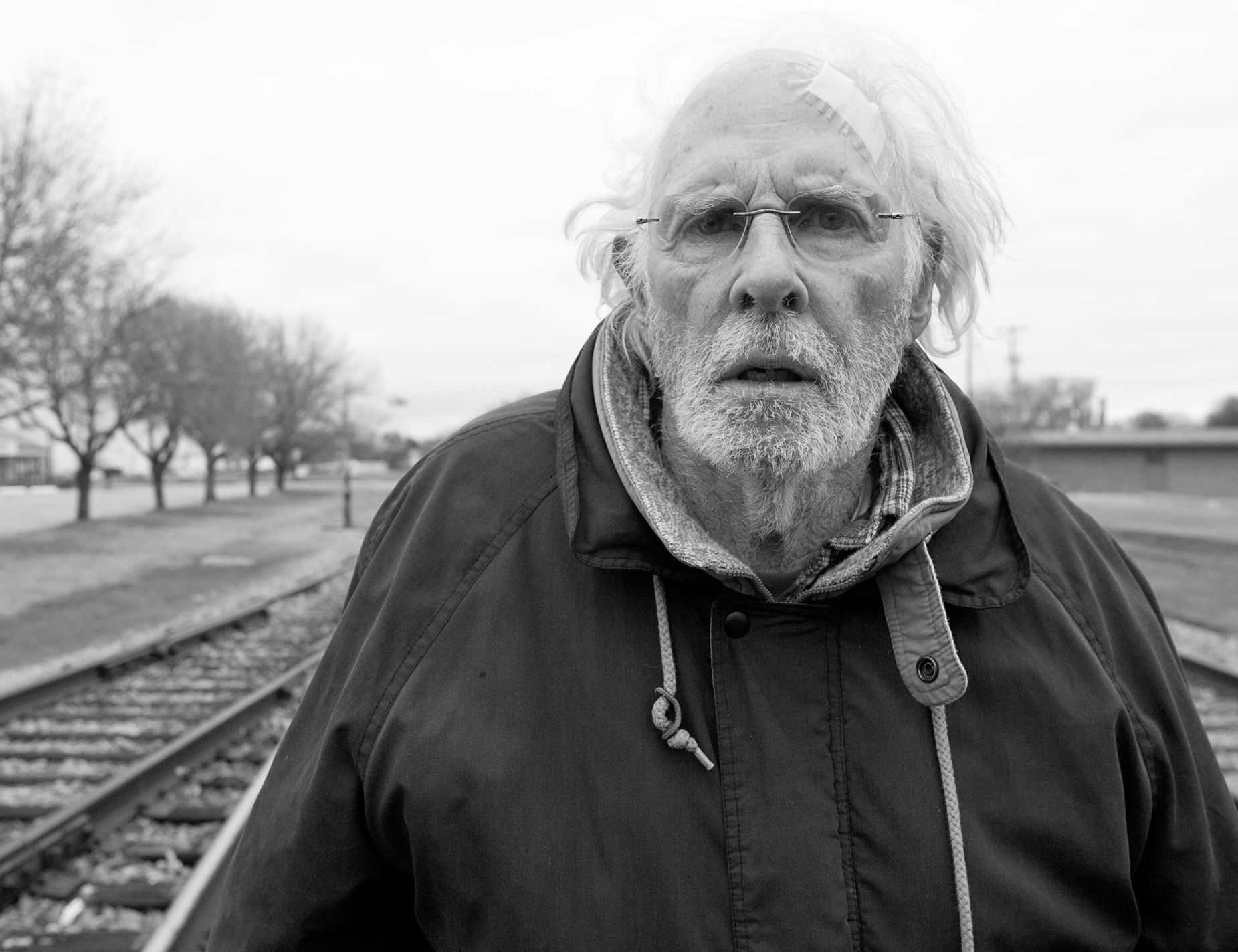
The movie tells the story of Woody Grant (played by the magnificent Bruce Dern), an old codger who receives a Publisher's Clearinghouse letter in the mail telling him he's won a million dollars and believes it. This sets him off on a quixotic quest from Billings, Montana to Lincoln, Nebraska in order to claim his prize.
At first, he tries to walk there, though he doesn't get very far thanks to the police. So, he has to enlist the help of his son David (played by the surprisingly subtle Will Forte). David knows it's a scam and suspects his father is suffering from dementia. But he also recognizes that his dad has little else to live for and, in many respects, neither does he.
On their way to Lincoln, they stop off in Woody's hometown to see his relatives and some of his old friends. David gets an opportunity to learn about his father's past, which allows him to finally connect with the old man in ways that were never possible in their icy dynamic. Most of these old acquaintances are quick to believe Woody's story, and some of them want in on the action. Indeed, at times it seems that only David, his brother Ross (played by Bob Odenkirk), and his mother (played by June Squibb) know what's going on.
Ultimately, Nebraska is both a tribute to small-town America and sort of a comic indictment of some of the people who live there. It's also a case-study in the friction that so often belies father-son relationships. It's shot in beautiful black and white, reflecting both the supposed simplicity of the life and values it portrays and the emptiness of the lives of its main characters.
I'm not going to pretend that I know much about Bruce Dern, though I've read a lot about him in relation to this movie. He's spent a lifetime in supporting roles, usually hamming it up -- as supporting actors often do -- in order to stand out. But, here he's all cloudy eyes and mumbles, portraying a man broken down by years of hard life and hard living. It's a slow-burn performance that pays off big time. He's likely destined for an Oscar nomination.
The supporting cast are all first-rate. Like I said, Forte shows all new levels of depth that you just wouldn't suspect after his years on SNL. And, June Squibb is simply outstanding. She steals every scene that she's in.
All told, Nebraska is a worthy entry into the canon of Alexander Payne. It is, in my opinion, one of the best movies of the year.
Remember what I said about Alexander Payne and his perfect, Pixar-like record? That he was as reliable as Christopher Nolan? Well, it's late at night, I'm tired, and I'm suffering from a minor case of writer's block. Now, I'm wishing that I had saved that description to talk about Thomas McCarthy, the director of Win Win.
But, I don't want to plagiarize myself. So...let me start over.
Alexander Payne is as reliable as Pixar and Christopher Nolan, but he's not quite as prolific and he works on a much smaller scale. His track record as a writer-director is virtually flawless, with a filmography that includes Citizen Ruth, Election, About Schmidt, Sideways, and, in 2011, The Descendants.
The only unfortunate thing about Payne's work is that there's not enough of it. Those five movies are the sum total of the features he's directed in his 15-year career. His last movie before this one, Sideways, came out nearly eight years ago. I have to admit, before the trailers for The Descendants started showing up online several months ago, I had kinda forgotten about him.
His movies tend to circulate around less-than-heroic figures, below-average Joes whose troubles are common and familiar and, more often than not, self-inflicted. Most of his protagonists tend to middle-aged men -- or, in the case of About Schmidt, a older-than-middle-aged man -- who are coming to terms with the disappointing lives they've created for themselves. While this is hardly a unique approach for modern cinematic storytelling, Payne's sincere affection for each of the schlubs he's created, even when they don't deserve it, is always refreshing. It's easy to create a loser just to make fun of him. But, that's not how Payne works.
The Descendants is a dramedy staring George Clooney as Matt King, a 40-something lawyer with a wife in a coma who is also a descendant of one of the first white land-owners in Hawaii. As the story unfolds, King is forced to deal with the shortcomings of his relationships with his wife and two daughters as well as decide for his extended family whether to sell their last tract of land to a developer. These two trials, while seemingly unrelated, become entangled in one another until, in the end, it becomes clear that they are, in fact, one in the same.