Showing posts with label Reviews. Show all posts

Thursday, October 23, 2014

Quick Hitters: In theaters

I hate doing this.  I hate when I'm too lazy to blog about the movies I've seen and they start to pile up.
But, what're you gonna do?

I've seen three movies in the last week, all of which deserve at least a small mention on the blog.  And, there are more movies coming out tomorrow.  Something has to be done, dear reader.  And, this is the only solution I can think of.

St. Vincent ***


This is a movie made for Bill Murray fans (and, really, who's not a Bill Murray fan?).  If you've seen the trailer, you know the premise and you can probably figure out the ending.  Still, the journey -- predictable as it may be -- is worth the ride.

Murray stars as Vincent, a drinker, smoker, and gambler who sleeps with a pregnant hooker (played by Naomi Watts).  He's in debt to bookies, his bank account is overdrawn, and, for some reason that we don't learn until later in the movie, he is in desperate need of money.

Enter a new family next door, including the soon-to-be-single mother Maggie (played by Melissa McCarthy) and her precocious son Oliver (played by newcomer Jaeden Lieberher).  Through all-too-cute circumstances, Vincent starts to bond with the boy, and, even though no mother in real life would ever think of doing so, Maggie agrees to pay Vincent to watch her son after school.

The lame setup aside, St. Vincent is a terrific showcase for Murray's talents both as a comedian and, later in the film, a semi-dramatic actor.  It's weird to think that Murray hasn't taken on a leading role since Broken Flowers, nine years ago.  Since then, he's had the occasional supporting turn, usually in Wes Anderson films.  It's nice to have him back in the spotlight.

In a less competitive year, the performance would have an outside shot at an Oscar nomination.  This year, however, the field is just to crowded.

Like I said, this is a movie for Bill Murray fans.  If you like Mr. Murray, you'll like St. Vincent.


Fury **1/2


There's nothing really wrong with Fury.  And, there's a fair amount to appreciate.  It just feels like it's all been done before.  And, unlike the movie reviewed above, there's not a single character, performance, or action sequence that sets this movie apart.

The movie tells a one-day story about life inside a U.S. Army tank.  Stoic, yet charismatic leader?  Check.  Lots of southern accents?  Check.  Entirely too innocent newcomer to the unit?  Check.

Every character is given a single dimension and they never, ever deviate from it, which isn't a fatal flaw, but it robs the movie of something every great war movie needs: an emotional core.  The movie instead relies on its action sequences and little else.  And, truth be told, most of those sequences are competently staged and a few of the moments -- particularly those set during the climactic crossroads battle -- are downright thrilling.

But, like I said, it's all been done before.  And, in a lot of cases, it's been done much, much better.  Still, Fury is worth seeing if war movies are your thing.  Just moderate your expectations a bit and you'll likely enjoy the film.


Whiplash ***1/2
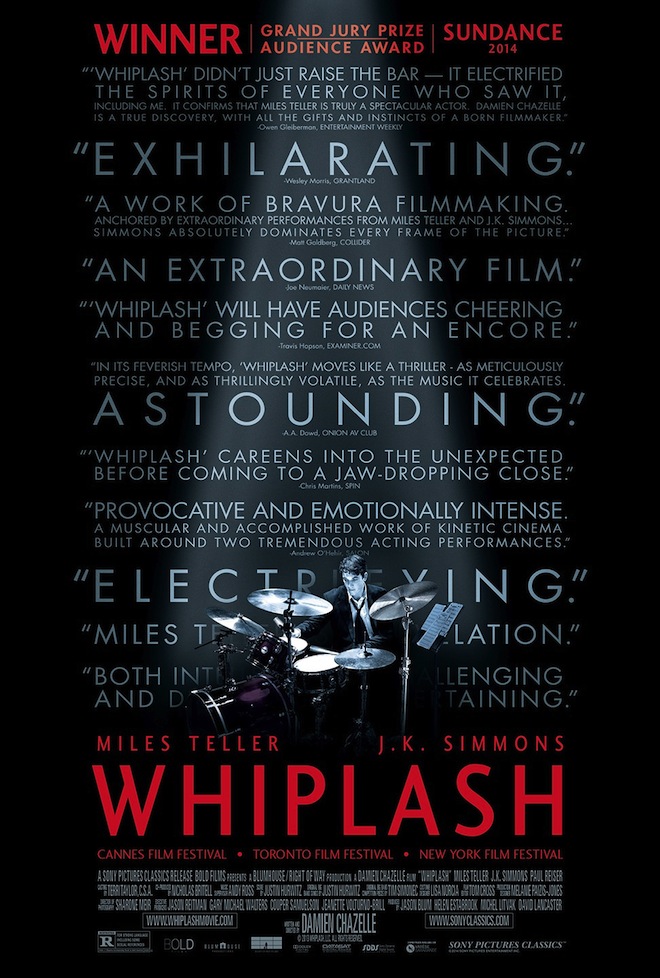


Whiplash is, quite simply, one of the best movies of the year so far.  Set in a world inside a fictional music school, the film artfully tells a fable about the price of perfection and the impact of obsession.  It's got a kinetic energy to it that just doesn't let up until the closing credits start to roll.

Miles Teller (whose career is currently on a crazy upward trajectory) stars as Andrew Neiman, a jazz drumming prodigy who is not satisfied with being great, he wants to be "one of the Greats."  And, J.K. Simmons (one of the best character actors in the game) plays his teacher, who is more like sadistic drill sergeant than an educator.  The movie succeeds, in large part, on the strength of these performances and the exceptional interplay between the the two characters.

Teller has a gift for giving off sort of a cocky vulnerability, and it's in full force here.  Even when he's being a jerk, you always feel for him.  And, when he pushes himself beyond his limits -- whether it's for himself or for his teacher -- you feel his pain.  He's a star in the making.

Simmons is, pardon my French, doing some next-level shit in this movie.  Give him the Best Supporting Actor Oscar now.  He is ferocious and terrifying, oozing both charisma and shocking sadism out of every single pore.  It's like he's been building up his anger after years of playing goofy, lovable sad sacks and decided to release every bit of anger and frustration into this performance.  It's a sight to behold.

The music, the vibe, and just the overall feel of this movie click the whole way through.  True enough, the story takes at least one somewhat unrealistic turn, but, by that time, I was too into it to care.  This is a really, really cool movie.


Sunday, October 12, 2014

In Theaters: The Judge *1/2


Yeah...this is going to be a short post.  I don't like spending a lot of time writing bad reviews.

On paper, The Judge appears to be something special.  It has a great cast.  It had a great trailer.  In fact, when I saw the trailer the first time, I thought for sure this was surefire Oscar bait.  The previews seemed to scream: "For your consideration!"  But, now that I've seen the movie, the only thing I can compare it to is this parody trailer from a few years back:


Monday, October 6, 2014

Gone Girl ***


Toxic marriages.  Misogyny. Infidelity.  Gender roles and stereotypes.  The actual or perceived definitions of a "cool girl."  These are just some the many concepts that director David Fincher and screenwriter Gillian Flynn attempt to explore in Gone Girl, one of the first major Oscar contenders to get a wide release this year.

Adapted from Flynn's bestselling page-turner and almost fully utilizing Fincher's talent for the Dark Arts, this is a wildly entertaining piece of film-making.  The problem, I suppose, is that it's aiming to be something more and it falls just a little bit short.

Giving much of a plot synopsis would, unfortunately, spoil it all.  So, on that front, I'll be brief.

The movie stars Ben Affleck and Rosamund Pike as Nick and Amy Dunne, an all-too-good-looking couple caught in an bad marriage of epic proportions, though that only becomes clear as the story unfolds.  On the morning of their fifth anniversary, Amy disappears under mysterious and apparently violent circumstances.  And, as you might expect, Nick finds himself at the center of the police investigation.

What follows is a compelling mystery that moves from being a simple case of a missing person to surprising game of cat-and-mouse, with a twist about halfway through that, if you didn't read the book, will likely knock your socks off.

The movie delves deep into all kinds of human depravity.  People try -- often times successfully -- to destroy one another.  Innocence is lost and the darkest of foibles are exposed.  This is, of course, Fincher's specialty, having directed classic tales of moral decay like Fight Club, Se7en, and The Girl with the Dragon Tattoo.  Nobody does this kind of movie better, which, for me anyway, begs the question: Why is David Fincher, one of the most sought after directors in the game, retracing his steps?  He could have made this movie in his sleep.  Aren't there greater challenges for him out there?
That's not to say that this is a bad movie or a waste of time.  It's a fine film.  And, it's a mainstream, studio-backed movie aimed at adults, a niche that is all to often neglected in today's marketplace.  But, as a fan of Fincher, I would have preferred to see him sink his teeth into something more substantial.

The movie's flaws are the same as the book's.  Both the film and its source material take aim at large cultural and societal questions, only to neglect them in the end in favor of a narrative that works to pull the audience in without ever really making them confront the big questions the author originally raised.

Too literal to be satire or a parable and too over-the-top to be legit social commentary, Gone Girl finds itself caught in between two competing objectives: tell a good story or make a point.  Ultimately, it opts for the former, which is fine.  But why waste our time raising questions that you're not prepared to really explore?

I suppose I'm nitpicking.  This is, once again, a very fine film.  The cast -- particularly the two leads -- is very good, with excellent supporting turns by Tyler Perry as Nick Dunne's skeezy lawyer and Carrie Coon as his all-too-supportive twin sister.  The one exception: Neil Patrick Harris shows up in a pivotal role for which he's awkwardly under-qualified.

And, of course, Fincher's technical prowess is spot on.  The score (by Fincher's go-to guys, Trent Reznor and Atticus Ross) is one of the best of the year and the cinematography (by another Fincher regular Jeff Cronenweth) is unique and artful.  This is, on all fronts, a very well-made piece of work.

I really did enjoy this movie.  But, I think it might also end up being the most overrated film of the year.


Sunday, February 9, 2014

Best of 2013: #1 Inside Llewyn Davis


First things first: Shame on the Academy!

Seriously.

Nine movies nominated for Best Picture, and there's not room for Inside Llewyn Davis?  Not even a screenplay nomination?  I hate using the term "travesty" to describe missed Oscar nominations, but if the word ever applied, it does here.

Alright, now that I got that out of the way, let's talk about this wonderful movie.

I'm almost at a loss for what to write here.  That's probably why it's taken me several days to finally sit down and put this post together.  It's not that I don't understand the movie -- I'm at least 75 percent sure that I get it.   And, it's not that I'm having trouble describing the story.  The problem, I suppose, is that the film contains so many subtleties and nuances that I feel like any review I give of it is going to be vastly incomplete by comparison.

Oh well...what're you gonna do?

Put simply, Inside Llewyn Davis is about the art of giving up.  Or, to put it another way, it's about giving up on art.

Llewyn Davis (played by Oscar Isaac), the titular (sort-of) hero of the piece, is a folk singer working in Greenwich Village in the early 1960s right before Bob Dylan arrived on the scene and put it on the map.  The movie tells the story of one week in his Sisyphean effort to find fame and success in the music business.  This one week is either the most important week of his career -- the one where he decides to let it all go -- or it's the same as every other week in the endless cycle that is his life.  If you see the movie, you'll understand why it's not entirely clear which one it is.

Llewyn is a talented fellow, though he's no Bob Dylan.  He's also a bit of a jerk.  But, you have to feel for the guy -- his singing partner recently committed suicide (voiced in the music by Marcus Mumford).  The sadness from this loss hangs over the whole movie and Davis's whole character.  Still, that doesn't fully justify the way he treats people.  

For example, he mooches off of fellow musicians, he's rude to even his most supportive friends, he heckles other performers, and he impregnates other people's girlfriends, including Jean (played by Cary Mulligan).  In one pivotal early scene, he lets a cat escape from a friends apartment where he's crashing.  Oddly, this is the only lapse in courtesy that seems to trouble Llewyn at all.  Indeed, he spends half the movie either holding onto the cat or trying to chase it down.

Davis's story is essentially a folk tale, told by the Coen Brothers with their trademark whimsy-induced nihilism.  It is equal parts real and surreal as he travels through New York to Chicago and back again, singing songs and encountering various fairies and monsters along the way.  These creatures, of course, take human form, but that doesn't make them any less enchanting and/or horrifying.

There are the kind creatures -- some of the other musicians (played by people like Justin Timberlake and Adam Driver), the kind scholarly couple that end up being his biggest supporters, and Llewyn's sister and nephew.  And, there are the terrible ones -- the music promoters, the club owners, the union bosses, and John Goodman playing a heroin-addicted jazz musician.  Llewyn's biggest problem is that he's unable to hide his disdain for the nice people he encounters and he's not talented or charming enough to win over the others.

Because this is a Coen Brothers movie, you know from the beginning that things aren't likely to turn out well for Llewyn.  The fun part is finding out how they're going to test and torture him along the way.

There are two scenes that stick out in this regard.  The first is when he auditions for Bud Grossman (played by F. Murray Abraham), a famous club owners and talent promoter in Chicago.  He plays a song titled "The Death of Queen Jane," and he plays it beautifully, singing his heart out, the last verse acapella.  It's a beautiful moment...until Grossman reacts.  The second comes when he plays another song for his convalescing father.  Again, the music is wonderful and Llewyn's talent is on full display.  But, his father's response is, to put it lightly, probably not what he's shooting for.

The music plays a huge part of this movie, not unlike an earlier Coen movie, O Brother Where Art Thou.  Artists perform whole songs throughout the film, and the vast majority of them are performed live right on film.  Not only is this my favorite movie of 2013, the soundtrack is my favorite album of the year.  I want to curl up and live inside the music from this movie.

While the story of the film is generally cold and unfeeling, the music conveys far more warmness emotion than you're used to from a Coen-produced movie.  Indeed, the music allows the movie to give the audience a fuller emotional experience.  As a result, this is, quite possibly, the Coen's best, most complete work to date.

Much of that stems from the Isaac's performance as the title character.  His performance is a master-class in acting, not only in how he plays through the character's different layers, but in how he soulfully performs the music (he does all his own singing and guitar playing).  With a lesser actor, Llewyn could have just been a sarcastic jerk.  With Isaac in the part, we get to understand all the sources of his melancholy and his inability to connect even with people who love and support him.  His failure to get an Oscar nomination for this part is another "travesty."

All in all, this is just a staggering film.  In terms for where it fits in the Coen Cannon, I'd say that it's a fair cross between O Brother Where Art Thou and A Serious Man, sort of a illegitimate offspring of those two vastly different pieces of work.  Like O Brother, this is a surreal journey with characters that are a little too archetypal to be fully realistic.  Plus there's the music.  Like A Serious Man, this movie a ponderous look at a character being run through the existential ringer only to come out even worse on the other side.  And, like that film, it benefits greatly from repeat viewings.  In other words, go see this movie...and then see it again.

Like I said, Inside Llewyn Davis may very well be the best Coen movie yet.  Whether that's true or not, it is, in my opinion, the best movie of 2013.


Thursday, January 23, 2014

Best of 2013: #4 Her


In the opening scene of Her, the latest film from the brilliant director Spike Jonze (and the first movie he's written), we seen Theodore Twombly (played by Joaquin Phoenix) dictating a letter to his computer.  It's a touching letter expressing beautiful thoughts about love and relationships.  However, we learn quickly that Theodore isn't writing this letter for himself -- he's not a woman and he's clearly too young to be writing about his 50th wedding anniversary.

No, Theodore's job is to write letters -- deeply personal and meaningful letters -- for other people.  He works at a company that provides this service to an apparently broad and diverse clientele.  It's in these opening moments that we learn the central question the movie will be asking:  How will human beings connect with one another in a future that has us growing ever apart?

This is an ambitious undertaking.  And, to be honest, I'm not sure that the movie does it adequate justice.  But, even if it falls short of its goals -- and I'm not saying it does -- the movie takes us an wonderful philosophical ride.

Theodore's story takes place in the not-too-distant future, when, among other things, people outsource their most personal interactions.  That is what keeps him employed.  And, despite his apparent gift for simulating connections for other human beings, Theodore Twombly has a difficult time making and sustaining connections with other human beings.  This, we learn, is what ended his marriage to Catherine (played by Rooney Mara).  And, it's what keeps him isolated in his lonely apartment night after night.

This all begins to change when he meets someone new.  That someone is a new operating system (OS) for his computer and cell phone.  After answering a few preliminary questions, Theodore calls his OS into existence and, immediately, she (it?) begins to evolve.  Her first order of business: naming herself Samantha (voiced by Scarlett Johansson).

You buy Samantha as a real character right away.  As she goes about organizing Theodore's life, she expresses support and empathy all along the way.  It's easy to see why he takes comfort in her company, even though she's not there with him physically.  After a few weeks a late-night conversations about life and trips around a futuristic Los Angeles where Samantha sees the world through the camera on Theodore's phone, the two begin to fall in love.

I won't go into too much detail beyond the boy-meets-OS premise.  Instead, I'll just say that what follows is a meditation on the complexity of all human relationships, how relationships change as people change and how one person's expectations can set another person up for failure.  In the movie, these complexities exist -- and are in many cases amplified -- even when one of the "people" in the relationship doesn't have a body.

The movie doesn't prescribe answers to the questions it poses.  In a late night conversation with his best friend (played by Amy Adams), Theodore asks, "Am I just in this because I'm not strong enough for a real relationship?"  To which she responds, "Is it not a real relationship?"  There's never a full and complete answer to that question.  All you know is that it feels real to those involved and you see how it impacts them.

Yes, there are distinct elements of classic science fiction in here.  There are computers that become self-aware and begin to expand their views and desires beyond their original programming.  But, this is all just backdrop for the central love story and the exploration of human nature that the movie is trying to undertake.

It may all sound gimmicky and a little creepy, but that's not the way it plays on screen.  Jonze has created a space where these two characters develop without judgment or irony.  And, it works -- one hundred percent.  You don't feel sorry for Theodore and his relationship with his computer.  You don't laugh at their interactions, except in those moments where you actually relate to what they're going through.  Instead, you watch this relationship develop with wonder and curiosity, just as you would any other relationship between two movie characters.

It's a testament to great writing and filmmaking.  Spike Jonze is the man.

Of course, it helps that he has Joaquin Phoenix playing the lead.  With this role, he lets go of his trademark intensity and machismo.  What's left is a natural vulnerability that I don't think he's ever displayed before.  He's in virtually every shot of the movie.  And, his sensitive, sympathetic portrayal of the main character is what drives the movie forward.  I won't say that he was robbed of an Oscar nomination...but he, like many other actors last year, gives an awards-worthy performance in this film.

Scarlett Johansson's performance is almost just as extraordinary.  Though you never see her, she fully inhabits Samantha, giving her life and dimension that doesn't really seem possible.  I don't believe in handing out awards for voice acting.  But, if a voice-only performance ever deserved awards consideration, it's this one.

Long story short, this is just a fantastic film.  I've seen it twice, and it holds up beautifully.  In almost any other year, this film would likely be at the very top of my list.  But...2013 wasn't just any year.


Saturday, January 18, 2014

Best of 2013: #5 The World's End


I know what you're thinking.  A movie like The World's End doesn't belong on a Top 10 list.  Top 10 lists are for super-serious Oscar-bait and not for raucous and unruly comedies that can't even decide what genre to be in.  

Well...shutup.  You're wrong.  And, it's a pity that so much of the world thinks like you do, because, if there was any justice in the world, movies like this would win Oscars.

The World's End is one of the best comedies in years.  It's story and performances are sublimely layered and, yes, pretty darn subtle.  The direction is insanely tight -- indeed, for a slapstick comedy about beer and killer robots, there's not an ounce of fat on it.  And, the script is easily one of the best of the year.

Put simply, this is a great movie.  Damn The Man.

This is the capstone to the heralded Three Flavours Cornetto Trilogy brought to us by director Edgar Wright and his co-writer and star Simon Pegg.  The previous two films in the trilogy -- Shaun of the Dead and Hot Fuzz -- were wonderful send-ups of genre filmmaking and were both brilliant in their own right.  However, with The World's End, Wright and Penn have outdone themselves.  This is their best work so far, in my sort-of-humble opinion.

The story begins with an introduction to Gary King (Pegg's character) as he gives a recount of the best night of his life.  Sadly, that night took place in high school, when he and his four best friends went on an unsuccessful pub crawl through their hometown.  Even sadder, he's telling this story in what is apparently a rehab facility.

For some unknown reason, Gary decides that it's time to try to relive that night, to retry the pub crawl -- referred to affectionately as "The Golden Mile" -- with his old friends in tow.  So, he set's off  to try to convince his old buddies to come along.  Of course, they've all grown up and moved on.  And, as you might expect, they don't really have room for Gary and his stunted development in their lives.

Gary's friends are all perfectly cast.  Oliver (played by Martin Freeman) is a boring real estate agent always tied to his Bluetooth.  Steven (played by Paddy Considine) is a divorced construction foreman constantly reminding everyone that he's dating a 26-year-old personal trainer. Peter (played by Eddie Marsan) is the son of a rich auto dealer who's now in the family business.  And, of course, there's Andrew (played by Pegg and Wright's third musketeer, Nick Frost), a lawyer who, for reasons that aren't immediately known, no longer wants anything to do with Gary.

Gary visits each of his friends separately and convinces them to once again attempt to traverse The Golden Mile.  And, though they are all reluctant, they eventually agree to come along, each for their own reasons.

Now, you could make a pretty decent movie about five old friends returning to their boring hometown for a pub crawl.  You'd have a story about growing up and growing old.  Friendships rekindled.  Demons confronted.  All of that's in there, of course.  But, the movie is so much more than that.

Upon their return home, Gary and his friends come to learn that home isn't what it used to be.  First of all, their favorite pubs have all been watered down -- "Starbucked" is the term they use -- to the point where they're all the same.  And, second, all of the people in town have been replaced by robots of an unknown origin.  I don't want to give too much away regarding what we eventually learn about the robots and their intentions.  I'll just say that the pubs aren't the only thing they're trying to Starbuck.

So, yes, what started out as a you-can't-go-home-again comedy eventually morphs into a sci-fi action movie.  It comes complete with outstanding special effects and beautifully choreographed fight scenes.  All of it moves toward a climax that is one of the funniest scenes ever put to film.

For Simon Pegg fans, he's at the top of his game here, both as a comedic actor and an actor actor.  It may not seem like it at first, but there's a lot going on underneath the surface with Gary King. As always Pegg and Frost play off of each other perfectly.  Seriously, I'd watch these two read the phonebook, so long as they were doing it together.

But, the real star of the movie is the screenplay, which is damn near perfect.  They set up every joke and knock down every punchline.  The whole thing moves like it's on a clock, never dragging, never obsessing over its own ideas.  Like I said, it's one of the best scripts of the year.

What a glorious movie.  I've seen it three times already...and I can't wait to see it again.


Tuesday, January 14, 2014

Best of 2013: #6 Fruitvale Station


Over the last few months, I've read a number of reviews and articles about Fruitvale Station.  Almost all of them, I think, miss the point.

The movie tells the true story of Oscar Grant (played by Micheal B. Jordan), a young African American man who was senselessly shot and killed by police on New Year's Eve 2009.  From that description alone, you're likely to conclude that this is a movie about race -- or, more pointedly, about racism -- in America.  That's certainly what a lot of commentators and critics have inferred from the movie, many of them arguing, for example, that the story gained more resonance after the shooting of Trayvon Martin.

But, I don't think that's what this movie is about.  At least, it's not what I got from it.

Instead, I believe Fruitvale Station is a movie about the interconnectedness of all people and the value of a single human life.   And, while the movie is certainly race-conscious, I don't think the story it's trying to tell is race-centric.  I suppose you could say that it's like the movie Crash, but with about 100 times more grace and subtlety.

While Oscar Grant's story is most noteworthy for the circumstances surrounding his death, the movie opts to tell the story of his life.  In the end, it is the life he led that made his death such a tragedy.  In watching Oscar go through his last day, we learn about the people in his life -- his girlfriend, his daughter, his friends, and, of course, his mother (played by Octavia Spencer) -- and the impact he had on them.  We see him interact with perfect strangers, offering assistance and conversation to random people that he meets.  And, we see him try to save a dog after its been hit by a car.

Oscar's not a saint.  He's done time in prison for selling drugs.  And, though it landed him in jail, he considers going back to that life after he loses his job at a grocery store. He's cheated on his girlfriend.  He makes promises to his mother that he doesn't deliver on.  The movie goes to great lengths to show that Oscar isn't perfect, but that doesn't make him any less deserving of basic human respect and dignity.  Moreover, as the movie shows us, it doesn't mean that he can't influence the lives of others for good.

All of this builds toward a climax on a metro station platform and the fateful encounter with the police.  But, in my opinion, it's the moment right before that that brings the movie home.  Oscar and his friends are trapped on a train with dozens of other people, missing the New Years' Eve celebration.  At that moment, people from different races and backgrounds all join together to celebrate the moment, demonstrating one last time how everyone, despite their differences, is connected to everyone else.

Sure, it's a little corny.  And, maybe it's overreaching. But, it works.

When Oscar finally does have his run-in the with the police, the movie takes great care not to get inside the mind of the cop who shoots Oscar.  We never learn his motivation.  In fact, he's barely on screen for more than a few seconds.  At first I thought this was a flaw in the story-telling.  But, after a while, I realized it was essential.  The mindset of the police officer isn't important.  That's not the story the movie is telling.

In my view, that is why the Trayvon Martin comparisons are so misleading.  Everyone's view of the Trayvon Martin story is determined, in large part, by what they think George Zimmerman's intentions were.  In Fruitvale Station, the intentions of the shooter are irrelevant.  Oscar Grant's death is a tragedy, not because a policeman may have been racist -- once again, we don't know -- but because of the life he was trying to live and the people he touched.

I don't know, maybe it's me who's wrong.  But, that's how I saw it.

The movie works in large part because of the performance of Michael B. Jordan.  He is, to put it simply, a force to be reckoned with.   Many people saw him on TV shows like "The Wire" and "Friday Night Lights," where he was very good.  But, this is all new territory for him.  He is in every scene, almost every shot, and he holds your attention every step of the way.  It is one of the best performances by an actor in 2013.

The movie was written and directed by Ryan Coogler.  This is his first feature.  And, while it's a little rough around the edges -- like first movies often are -- the film shows great restraint.  He never goes over the top, though it would have been easy to do so.  And, rather than overreaching on the overall message, the movie always stays grounded in the reality of Oscar Grant's life.  It's a sight to behold.  

I loved this movie.  It's powerful.  It's unique.  It's one that you won't soon forget.


Sunday, January 12, 2014

Best of 2013: #8 Short Term 12


The first thing I noticed when I watched Short Term 12, the brilliant piece of indie-film work from director Destin Cretton, was that it is better than its premise.  Far better.

Movies like this always tend to devolve into a sort of schmaltzy after-school-specialness that overwhelms the senses and drowns out anything unique or particularly praiseworthy about the rest of the movie.  But, this movie doesn't do that, and it's a testament to the filmmaker -- not to mention a wonderful cast -- that it doesn't.

The movie is set in GoldDerby, a short-term care center for at-risk kids.  The supervisors of the center -- those spending the most time with the kids -- are a bunch of 20-somethings, really just kids themselves.  The lead supervisor is Grace (played by Brie Larson), who's hiding a long-term relationship with her co-worker Mason (John Gallagher Jr.).  Grace and Mason aren't doctors our counselors -- we learn that very early on -- they are just there to provide a safe supportive environment for the kids.  And, that's what they do, day in and day out.

The story runs on two separate tracks.  The first is just a sort of a slice-of-life track , demonstrating what life is like in a facility like this.  Cretton apparently worked in one of these places for a few years, and it shows.  The scenes inside GoldDerby all feel incredibly authentic, never glossed over, but also never exploited to make it seem disturbing or scary.

These scenes work because of the director's attention to detail.  We see them hand out the meds.  We watch them play games none of the kids really like.  We see the supervisors search rooms for contraband.  At every step, the audience if fully immersed in the life of these kids.

This track of the story also works because the kids are never caricatures or stereotypes of what you'd expect of kids in a group home -- they are fully realized characters.  Chief among them is Marcus, who writes rap songs to deal with the traumas of his youth and is stressed because he's about to turn 18 and age-out of the home. There's also Jayden, a cutter with attitude that masks deeper problems than what you see on the surface.  All of the kids have their moments and, like I said, it all works.

The second track of the story is an exploration of Grace's character.  As the story unfolds, we learn about the horrors of her childhood and how they're coming back to haunt her.  And, with Jayden's arrival at GoldDerby, she's remind of feelings she's tried to repress.  These same feelings keep her from having a full and healthy relationship with Mason, who, we learn, also had a troubled youth.

As I describe this, I'm' fully aware that Short Term 12 sounds like a generic message movie, but it's not.  Believe me.

At every point when the movie feels like it's headed down that road, Cretton's direction and story takes the audience elsewhere, somewhere deeper and more meaningful.  He's never heavy-handed, never selling out to sentiment or convention.  Even in the third act, when characters make some extreme decisions, Cretton never overplays his hand.

It's a masterful piece of filmmaking all the way around.  I can't wait to see what he does next.

It helps that he has Brie Larson in the lead role.  If you see a lot of movies, you've seen her around...but not like this.  This is a truly revelatory performance.  It's a low-key, slow-burn endeavor.  She's not chewing up any scenery or putting on a show.  But, she's aiming straight for your heart, and she hits it dead center.

It's shame that this movie wasn't marketed a little better.  If it were, Larson would definitely be in the Oscar conversation.

All in all, this is just a fantastic little film.  Indeed, it's the best movie no one saw in 2013.


ap

Tuesday, January 7, 2014

Best of 2013: #9 Nebraska


Okay...so...here's the thing:  I'm tired, lazy, and a little busy.  But, at the same time, I REALLY want to get through my posts the Top 10 movies of 2013.

As luck would have it, my Number Nine choice, Nebraska, is a movie I've already reviewed here on the blog.  My hope was to write an all new post.  However, did I mention that I was tired, lazy, and a little busy at the moment?

There's a lot more I could say about this movie that I didn't cover in my original review.  For example, I could write some more about what a great director Alexander Payne is. I could say something about how it this movie isn't just a beautiful tribute to small town America, but a larger examination of America as a whole.  I could mention that it also wonderfully examines deeper themes, like loss and regret.  Most of all, I could talk about how this movie burrowed its way deep into my mind and continued to haunt me for days after I saw it.

Yeah...I could totally go into all of that.  But, I'm not going to.  Instead, I'm going to give you a link to my earlier review and hope that you give it a read.

Sorry, dear readers.  I'll try not to do this with any other entries on my Top 10.


Sunday, January 5, 2014

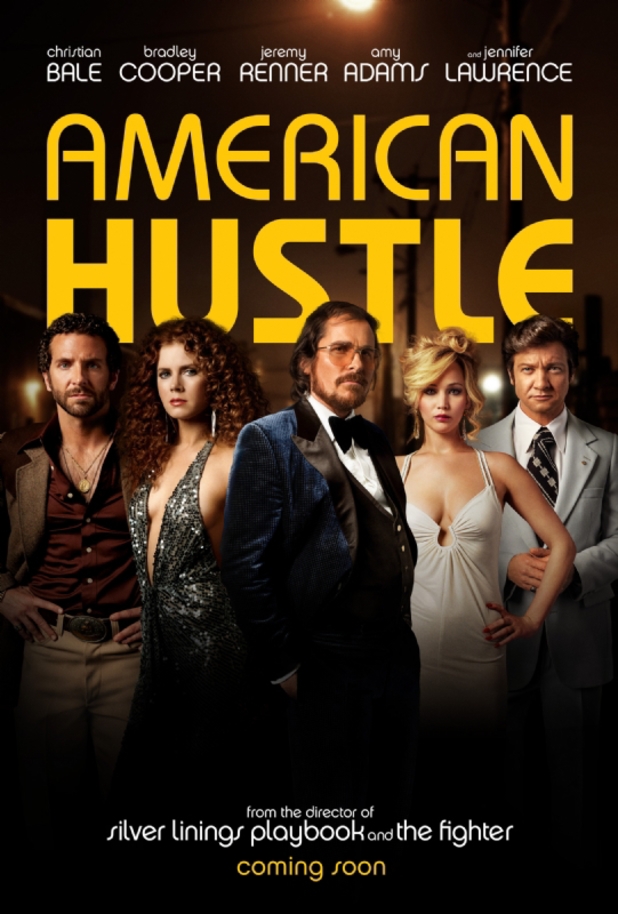
Best of 2013: #10 American Hustle


In the opening scene of American Hustle, Irving Rosenfeld (played by Christian Bale) stands in front of a mirror perfecting an epic comb-over with his hair.  He's meticulous, taking his time, even gluing in some fake hair for good measure.  The scene is hilarious, and it sets the stage perfectly for the rest of the movie.  

Irving is a fraud, just like everyone else in this movie.  

Irving owns a small chain of dry cleaners, but he makes most of his money through phony art deals and personal loan scams.  He's got a wife (played by Jennifer Lawrence) and an adopted son in Long Island, but his heart belongs to his partner in crime Sydney Prosser (played by Amy Adams), another fraud.  

Sydney's an Albuquerque transplant who came to New York dreaming remaking herself as a member of high society.  After meeting Irving and learning about his business model, she decides to don a fake accent and become Lady Edith Greensley, a British aristocrat with London banking connections, believing (correctly) that such an association would help with the fraudulent loans.  

Eventually, they try to scam the wrong guy -- Richie DiMaso (played by Bradley Cooper), an ambitious and delightfully hotheaded FBI agent.  Richie catches them in the act, but proposes that they help him catch other scam artists in return for avoiding jail times.  The result of their combined efforts is the FBI's Abscam operation, a real-life endeavor that eventually eventually lead to the convictions of seven members of Congress for bribery.  The movie, however, is a fiction.  

Richie is also fraud.  He's an underling at the FBI and he concocts this operation and let's it grow in size and complexity, even going around his superiors to do so, as a means of raising his stature.  Like Iriving, he sports a fake hairstyle, putting his hair in curlers every night, which is hilarious, by the way.  Eventually, he falls for Sydney, though he doesn't know she's not British or, for that matter, that her name is Sydney.  This, of course, is part of Sydney's plan, both to keep Richie close and to punish Irving.  And, it works.  Richie is sucked in by her life as a scam artist -- the parties, the dance clubs -- even though he's got a plain fiance stashed away at home. 

In the end, all three lead characters are scamming each other and the movie is a race to see who will scam who last.  The most honest character in the movie is the original target of their operation, Camden, New Jersey Mayor Carmine Polito (played by Jeremy Renner), who, from the outset, takes bribes and offers them to others.  

All of this plays out with a rare kinetic intensity, playing fast and loose as the story unfolds.  Though the plot is detailed and convoluted, the movie feels a little sloppy at times, which is actually a big part of its charm.  This isn't Oceans Eleven or The Sting.  No one in the movie is all that smart no one has an over-arching plan.  Sure, there are scams and double-crosses, but they are made up as they go along.

This on-the-fly construction is the genius of director David O. Russell, who has really come into his own with his last three movies -- The Fighter, Silver Linings Playbook, and, now, American Hustle.  Don't get me wrong, he was great before that, too.  But, with these movies, he's established himself as one of the best mainstream filmmakers around.    

As with Russell's previous films, the acting in this movie is superb across the board.  Adams and Russell give career-best performances, both worthy of Oscar consideration, though, from the looks of things, they're not likely to get it.  Bale is great as always, though, to be honest, it's probably his second best performance of the year, behind Out of the Furnace.  Renner is also very good.

However, the most memorable performance in the movie is that of Jennifer Lawrence, playing Irving's needy, passive-aggressive wife who gets just involved enough in the operation to screw things up.  She's a firecracker, an absolute scene-stealer.  She's destined to receive her third Oscar nomination for this role.  And, as I've said before, she's one step closer to world domination.  

In the end, the movie drags out a bit too long and the final scam is one you should probably see coming if you've seen movies like this before.  But, it never stops being fun and the characters never stop pulling you in.  This is what happens when good filmmakers and great actors get together.  


Saturday, December 21, 2013

More Quick Hitters

Alright, here's the thing, I'm currently four movies behind.  I have a little of an OCD thing going on where I hate to write about movies out of order.  And, now that I'm on Christmas break, I'll be seeing even more movies and I'll likely fall further behind.

Something needs to be done about this.

As luck would have it, I don't have particularly strong feelings or deep thoughts about any of the four movies currently in the queue.  So, even though I hate writing quick-hitter reviews, I'm willing to do so in the name of catching up.

None of this means anything to you, dear reader, I'm aware.  But, putting this explanation out there makes me feel a little better about shirking my blogging duties.  So...here we go.

The Hunger Games: Catching Fire ***


Unless you're living under a rock somewhere, chances are you've already seen this movie.  So, I don't feel the need to say a whole lot here.

If you liked the first Hunger Games movie, you'll like this one.  It's competently made and well-acted.  Unlike the rest of the planet, I never read the second book, so I didn't know what was going to happen.  The movie kept me interested the entire time.

And, of course, with this movie, Jennifer Lawrence takes another step on the path toward world domination.


Out of the Furnace **1/2


I was interested in this movie from the moment I saw the first trailer.  Sadly, it failed to live up to expectations.  It's not a bad movie, just not as good as I'd hoped.

A tribute to the dying way of life in the Rust Belt, Out of the Furnace features an outstanding leading performance from Christian Bale, playing a Russell Baze, a steel-worker haunted by disturbing memories and a tough life.  His brother, played by Casey Affleck, an Iraq war veteran, starts running with the wrong crowd and eventually finds himself in over his head.  Russell takes it upon himself to try to save him.

Overall, the movie showcases some fine acting from it whole ensemble.  Bale's performance is one of the best of his career, though it lacks a big scene to tie it all together.  Affleck is also very good.  Willem Dafoe and Sam Shepard also turn in noteworthy performances.  And, of course, there's Woody Harrelson chewing up the scenery as the villain of the piece.

In the end, it's not the actors that are the problem, it's the script.  The movie succeeds thematically and in terms of tone.  It just never seems to go anywhere -- it's all premise, not enough story.  Still, it's worth your time, particularly if you, like me, are a fan of the actors.

What sets this movie apart, however, is its effective use of the song "Release" by Pearl Jam.  Why has that song never appeared on a soundtrack before?


Philomena ***


This is another movie that succeeds mostly on the strength of its lead performance.  Judi Dench, in fine, Oscar-worthy form, plays Philomena Lee, a woman who lost her illegitimate son at the hands of some Catholic nuns.  Fifty years later, she joins journalist Martin Sixsmith, played by Steve Coogan, on a journey to find her child.

It's a true story, by the way.

The interplay between Dench and Coogan is wonderful, shifting from hilarious to philosophical to theological, often in the same scene.  And, the story pipes along at a good pace.  If there's a fault in the movie, it's that it tries too hard to be whimsical when the subject matter is often very sad and serious.

Still, it's a fine film.  Dench will deserve her certain Academy Award nomination.


Anchorman 2: The Legend Continues ***


A worthy sequel to one of the indispensable comedies of the last decade, Anchorman 2 succeeds in most of the same ways its predecessor did.  In the end, you could probably just say that they've made the same all over again -- and that's not a bad thing.

The original struck a chord with me that few comedies about idiots ever have.  Though, I have to say that, while I rarely go a day without uttering a quote from the original, I don't know that I'll be saying the same thing about this one.

This movie's one weakness:  Too much Steve Carell. While Brick was pretty much just a funny set piece in the original, he gets his own subplot in this one. And, every time it shifts to that story, the movie goes from stupid-funny to just stupid-stupid.

But, honestly, I'm nitpicking.  Overall, this movie is hysterical.  The climactic battle sequence, which mirrors a similar scene from the first movie, may be the funniest thing I've seen all year.


Monday, December 9, 2013

In Theaters: Nebraska ***1/2


I've written about Alexander Payne -- one of the finest directors working today -- on this blog before.  A couple years back, I wrote a review of his last film The Descendants where I said this:
His movies tend to circulate around less-than-heroic figures, below-average Joes whose troubles are common and familiar and, more often than not, self-inflicted.  Most of his protagonists tend to be middle-aged-men -- or, in the case of About Schmidt, an older-than-middle-aged man -- who are coming to terms with the disappointing lives they've created for themselves.  While this is hardly a unique approach for modern cinematic storytelling, Payne's sincere affection for each of the schlubs he's created, even when they don't deserve it, is always refreshing.  It's easy to create a loser just to make fun of him.  But, that's not how Payne works.  
I reread that as I sat down to write this review and my first thoughts were: 1) I think I'm a better writer than I was back then, and 2) Nebraska is, in many ways, par for the course with Alexander Payne.

The movie tells the story of Woody Grant (played by the magnificent Bruce Dern), an old codger who receives a Publisher's Clearinghouse letter in the mail telling him he's won a million dollars and believes it.  This sets him off on a quixotic quest from Billings, Montana to Lincoln, Nebraska in order to claim his prize.

At first, he tries to walk there, though he doesn't get very far thanks to the police.  So, he has to enlist the help of his son David (played by the surprisingly subtle Will Forte).  David knows it's a scam and suspects his father is suffering from dementia.  But he also recognizes that his dad has little else to live for and, in many respects, neither does he.

On their way to Lincoln, they stop off in Woody's hometown to see his relatives and some of his old friends.  David gets an opportunity to learn about his father's past, which allows him to finally connect with the old man in ways that were never possible in their icy dynamic.  Most of these old acquaintances are quick to believe Woody's story, and some of them want in on the action.  Indeed, at times it seems that only David, his brother Ross (played by Bob Odenkirk), and his mother (played by June Squibb) know what's going on.

Ultimately, Nebraska is both a tribute to small-town America and sort of a comic indictment of some of the people who live there.  It's also a case-study in the friction that so often belies father-son relationships.  It's shot in beautiful black and white, reflecting both the supposed simplicity of the life and values it portrays and the emptiness of the lives of its main characters.

I'm not going to pretend that I know much about Bruce Dern, though I've read a lot about him in relation to this movie.  He's spent a lifetime in supporting roles, usually hamming it up -- as supporting actors often do -- in order to stand out.  But, here he's all cloudy eyes and mumbles, portraying a man broken down by years of hard life and hard living.  It's a slow-burn performance that pays off big time.  He's likely destined for an Oscar nomination.

The supporting cast are all first-rate.  Like I said, Forte shows all new levels of depth that you just wouldn't suspect after his years on SNL.  And, June Squibb is simply outstanding.  She steals every scene that she's in.

All told, Nebraska is a worthy entry into the canon of Alexander Payne.  It is, in my opinion, one of the best movies of the year.


Sunday, December 8, 2013

In Theaters: Dallas Buyers Club ***


I could be wrong, but I assume that those who read these reviews focus primarily on the star-ratings I give to individual movies and don't pay attention to much else.  I know that's how I often read movie reviews.  And, in general, I figure everyone is like me.

That's unfortunate, particularly with a movie like Dallas Buyers Club.  There are parts of this movie -- particularly the performances -- that are off-the-charts incredible.  There are other parts the movie that are just mediocre.  I highly recommend this movie so that people can get a gander at its more praiseworthy elements.  But, ultimately, taken as the sum of its parts, I can't give this movie a stellar overall rating.

Someday, I'm going to write a whole blog post explaining my star-rating system.  Until then, just know that three stars basically means the movie is good but far from great.

That's my overall assessment of Dallas Buyers Club.  But, while it's only a three star movie, it contains a couple of four-star performances.

One of those is from leading man Matthew McConaughey, who plays Ron Woodroof, a bull-riding homophobe who was diagnosed with HIV in 1985 and given 30 days to live.  Determined to live, he bribes a hospital janitor into stealing bottles of AZT, the only drug available at the time to treat HIV and AIDS.  When the scheme is uncovered, he heads to Mexico, where an unlicensed American doctor starts treating him with a series of vitamins and proteins that have not been approved by the FDA.  This unapproved treatment is aimed at the symptoms of HIV instead of trying to eradicate the virus.

Ron begins to feel better and immediately sees a business opportunity.  He decides to smuggle these substances into the U.S. in order to sell them to American AIDS patients.  To temporarily skirt the law, he sets up a "buyers club," wherein his customers pay a monthly membership fee and he "gives" them the drugs.  This scheme is a success as it both extends Ron's life and makes him a ton of money.

The success of the endeavor is due in large part to Rayon, a transgendered woman played by Jared Leto in the film's other incredible performance.  She is Ron's secret weapon, giving him credence in Dallas's gay community that the bigoted rodeo fanatic couldn't attain on his own.

Like I said, both of these actors are beyond exceptional in these roles, destined for award nominations, both with legitimate shots at taking home a statue on Oscar Night.

McConaughey is in the middle of a highly-touted career transformation and Dallas Buyers Club is the capstone.  He is ferocious and awe-inspiring in this movie.  The performance is more than a physical transformation (though he did lose some 40 pounds for the part).  He inhabits every inch of this character and plays it with both flash and nuance.  It is truly a sight to behold.

Much the same could be said of Leto's performance, which is both heartbreaking and revelatory.  He plays Rayon with an uncanny grace and fearlessness that you just wouldn't expect from someone best known as the lead singer of a really crappy rock band (FN1).

So, you might be asking, what's wrong with the movie.  Well, I'll tell you.

First of all, so much of the story hinges on the relationship between Ron and Rayon and, in the end, it all feels a little too forced.  Speaking of forced relationships, there's a doctor played by Jennifer Garner who eventually and without any real explanation becomes the biggest supporter of Ron and Rayon's cause.  On top of that, there are the villains of the whole thing -- the FDA and drug companies -- that are depicted with about as much nuance as Boris and Natasha from Rocky and Bullwinkle (FN2).  Much of the story the movie is trying to tell just doesn't feel true in the end, which is a problem for a movie that is supposed to be based on true events.

But, none of that should take away from McConaughey and Leto's brilliant work in the movie.  And, if you, like me, enjoy watching actors go for broke, I highly recommend this movie, even if it stumbles a little on its own intentions in the end.

FN1 -- Someone had to say it.

FN2 -- Nothing but the timeliest of references on this blog.  


Monday, November 25, 2013

In Theaters: All is Lost ****


One man, adrift for eight days on the Indian Ocean.

In a nutshell, that's what director J.C. Chandor's brilliant new film All is Lost is about.  Sure, there are details, but, to be honest, there aren't that many.  The main character doesn't even have a name -- he's credited as "Our Man."  There's no backstory, no explanation as to why he's on his boat in the first place, and, other than a few lines here and there, there's not really any dialogue.

I know it sounds like a bore, but it's not.  In fact, All is Lost is one of the most riveting and emotional movies you'll ever see.  The fact that it succeeds is a testament mostly to the ability of its leading man, Robert Redford, who brings to the role every bit of his trademark charisma and star power, along with a whole bunch of stuff we've rarely seen from him before.

The movie opens when Our Man's sailboat, the "Virginia Jean," collides with a floating shipping container, leaving a gaping whole in the side and disabling his navigation and communication equipment.  This sets off a chain of events wherein the man does everything he can to save his boat and then himself, all the time displaying the cool competence of an able seaman.  

Like I said, there are no other characters and Our Man doesn't stop to explain what he's doing out loud.  But, because the movie is so well shot and acted, the audience is never confused or at loss, we are engaged every step of the way.

Once again, I can't say enough about Redford's performance in this film.  He's always been more of a "movie star" than an "actor."  But, with this film, he is both at the same time.  He's spent over four decades building a relationship with movie-going audiences, which means that no backstory is necessary to make us root for him from the outset.  However, getting us on board is only half the battle -- he's also got to keep us there, all without playing off of other actors or even the benefit of dialogue.

He accomplishes this feat with a subtle, nuanced performance, conveying wit and intelligence without overplaying a thing.  By the time the film is over, the audience is mesmerized, following every movement and mannerism.  He will almost certainly be nominated for an Oscar...and he just might win.

Chandor's technical prowess behind the camera should also be praised.  I was not one those who went gaga over his directorial debut, Margin Call a few years back.  It was fine, it just didn't resonate all that much with me.  But, between that film and All is Lost, we may be witnessing the emergence of one of the most eclectic and versatile directors working today.  I am, no pun intended, completely on board to see whatever Chandor does next.

In short, this is a marvelous film.  One of the best of the year.  


Sunday, November 24, 2013

Quick Hitters: Ender's Game and Thor: The Dark World

So...yeah, it's been a while.

Not sure how it happened, but I currently owe reviews on five theatrical releases, not to mention a few movies I caught at home that I'd also like to write about at some point.

Tonight, I will begin the process of digging myself out of this hole.

Typically, I hate writing quick-hitter, capsule reviews.  I'm fully aware that I, myself, am the main beneficiary of this blog and, when I write just a short, one-shot review of a movie, I feel like I'm robbing myself of the writing exercise this blog was created to provide.  

But...what're you gonna do?

Luckily enough, a few weeks back, I saw two movies that I don't have strong feelings about.  Neither of these films were terrible, but they didn't really lend themselves to any sort of deep-dive analysis or recounting.  Thinking about them now, it's actually hard to remember more than just general details anyway.  In short, I don't think I'm doing myself -- or any of my five readers -- a great disservice by offering abbreviated reviews of these two films.

So, without further ado, I offer my short takes on both Ender's Game  and Thor: The Dark World.

Ender's Game **


I suppose I should say up front that the novel upon which this movie is based is not my favorite book of all time.  If it were, I would have been sorely disappointed.  As it was, my disappointment was only mild.  

This is basically a cliff's notes version of Orson Scott Card's sci-fi classic that gives short shrift to some of the most compelling parts of the original story and waters down everything else.  Ender's Game was always going to be a difficult cinematic lift and it would be impossible to get everything just right in a two-hour movie.  But, even if you give the filmmakers the necessary leeway to accomplish what it is a near-impossible task, it's hard not to think that there was a better movie in there somewhere.

The movie comes with spectacular visuals -- particularly in the scenes in the zero-gravity chamber wherein war-games commence -- enough to keep you from thinking you've completely wasted a couple hours of your life.  There's just very little there there when it comes to the story and the characters.

Asa Butterfield -- the star of the magnificent Hugo from a couple years ago -- seems miscast playing the titular hero.  But, that may just have been the dialogue.  And, as always, Harrison Ford -- playing the Colonel Gruff...err...Graff -- phones in another surly performance.

All in all, this is a nothing-burger a movie, which isn't all that bad.  It's just a little sad that they wasted so much of the potential that came with the source material.

Thor: The Dark World **1/2


Simply put, if you liked the first Thor movie -- a Flash Gordon-esque romp of stupidity that was somehow way better than it should have been -- you'll like Thor: The Dark World.  With this sequel, they've successfully recreated the tone and overall feeling of the first film and essentially made what feels like the same movie all over again.

That's not a complaint, just an observation.

The one thing missing from this second film is Tom Hiddleston's Loki.  Sure, he's in the movie.  But he doesn't have nearly the screen time that he deserves.  As Chris Hemsworth walks around flexing and while Natalie Portman and Anthony Hopkins make you wonder what they're doing in a movie like this, all you can do is wait for Loki to show up.  And, when he does -- for longer than a single scene -- it's the best part of the movie.

Yes, despite the name of the movie and Hemsworth's top billing, Tom Hiddleston is the undisputed star of the Thor franchise.  Deal with it.

In the end, this is a super hero movie.  If those types of movies are your bag -- and they're definitely mine -- you'll find more to like than to dislike with this movie.  That's precisely where I come down, hence the two and a half stars.