Showing posts with label In Theaters. Show all posts

Thursday, October 23, 2014

Quick Hitters: In theaters

I hate doing this.  I hate when I'm too lazy to blog about the movies I've seen and they start to pile up.
But, what're you gonna do?

I've seen three movies in the last week, all of which deserve at least a small mention on the blog.  And, there are more movies coming out tomorrow.  Something has to be done, dear reader.  And, this is the only solution I can think of.

St. Vincent ***


This is a movie made for Bill Murray fans (and, really, who's not a Bill Murray fan?).  If you've seen the trailer, you know the premise and you can probably figure out the ending.  Still, the journey -- predictable as it may be -- is worth the ride.

Murray stars as Vincent, a drinker, smoker, and gambler who sleeps with a pregnant hooker (played by Naomi Watts).  He's in debt to bookies, his bank account is overdrawn, and, for some reason that we don't learn until later in the movie, he is in desperate need of money.

Enter a new family next door, including the soon-to-be-single mother Maggie (played by Melissa McCarthy) and her precocious son Oliver (played by newcomer Jaeden Lieberher).  Through all-too-cute circumstances, Vincent starts to bond with the boy, and, even though no mother in real life would ever think of doing so, Maggie agrees to pay Vincent to watch her son after school.

The lame setup aside, St. Vincent is a terrific showcase for Murray's talents both as a comedian and, later in the film, a semi-dramatic actor.  It's weird to think that Murray hasn't taken on a leading role since Broken Flowers, nine years ago.  Since then, he's had the occasional supporting turn, usually in Wes Anderson films.  It's nice to have him back in the spotlight.

In a less competitive year, the performance would have an outside shot at an Oscar nomination.  This year, however, the field is just to crowded.

Like I said, this is a movie for Bill Murray fans.  If you like Mr. Murray, you'll like St. Vincent.


Fury **1/2


There's nothing really wrong with Fury.  And, there's a fair amount to appreciate.  It just feels like it's all been done before.  And, unlike the movie reviewed above, there's not a single character, performance, or action sequence that sets this movie apart.

The movie tells a one-day story about life inside a U.S. Army tank.  Stoic, yet charismatic leader?  Check.  Lots of southern accents?  Check.  Entirely too innocent newcomer to the unit?  Check.

Every character is given a single dimension and they never, ever deviate from it, which isn't a fatal flaw, but it robs the movie of something every great war movie needs: an emotional core.  The movie instead relies on its action sequences and little else.  And, truth be told, most of those sequences are competently staged and a few of the moments -- particularly those set during the climactic crossroads battle -- are downright thrilling.

But, like I said, it's all been done before.  And, in a lot of cases, it's been done much, much better.  Still, Fury is worth seeing if war movies are your thing.  Just moderate your expectations a bit and you'll likely enjoy the film.


Whiplash ***1/2
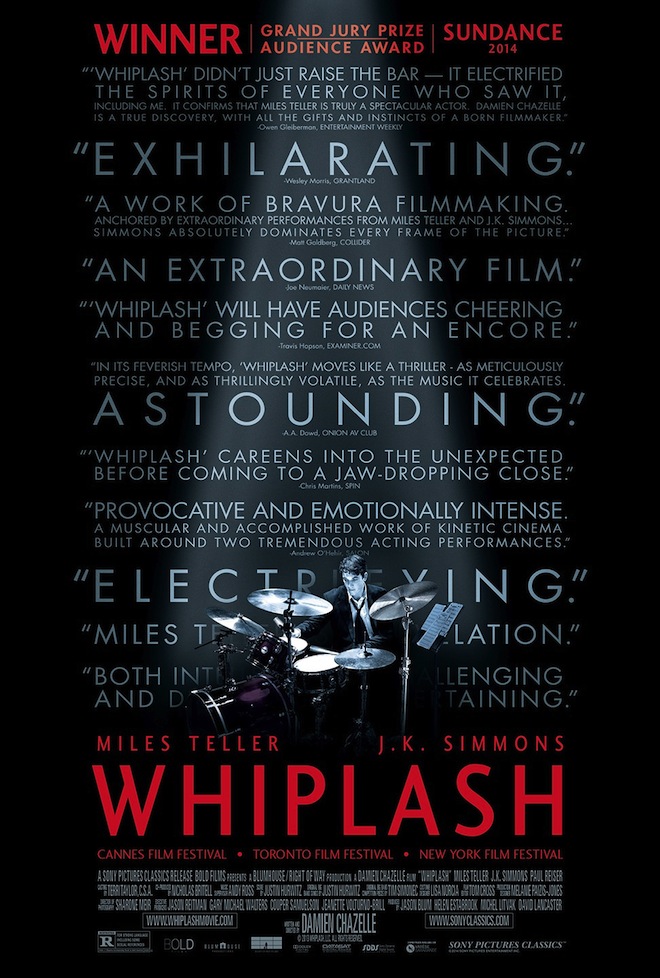


Whiplash is, quite simply, one of the best movies of the year so far.  Set in a world inside a fictional music school, the film artfully tells a fable about the price of perfection and the impact of obsession.  It's got a kinetic energy to it that just doesn't let up until the closing credits start to roll.

Miles Teller (whose career is currently on a crazy upward trajectory) stars as Andrew Neiman, a jazz drumming prodigy who is not satisfied with being great, he wants to be "one of the Greats."  And, J.K. Simmons (one of the best character actors in the game) plays his teacher, who is more like sadistic drill sergeant than an educator.  The movie succeeds, in large part, on the strength of these performances and the exceptional interplay between the the two characters.

Teller has a gift for giving off sort of a cocky vulnerability, and it's in full force here.  Even when he's being a jerk, you always feel for him.  And, when he pushes himself beyond his limits -- whether it's for himself or for his teacher -- you feel his pain.  He's a star in the making.

Simmons is, pardon my French, doing some next-level shit in this movie.  Give him the Best Supporting Actor Oscar now.  He is ferocious and terrifying, oozing both charisma and shocking sadism out of every single pore.  It's like he's been building up his anger after years of playing goofy, lovable sad sacks and decided to release every bit of anger and frustration into this performance.  It's a sight to behold.

The music, the vibe, and just the overall feel of this movie click the whole way through.  True enough, the story takes at least one somewhat unrealistic turn, but, by that time, I was too into it to care.  This is a really, really cool movie.


Sunday, October 12, 2014

In Theaters: The Judge *1/2


Yeah...this is going to be a short post.  I don't like spending a lot of time writing bad reviews.

On paper, The Judge appears to be something special.  It has a great cast.  It had a great trailer.  In fact, when I saw the trailer the first time, I thought for sure this was surefire Oscar bait.  The previews seemed to scream: "For your consideration!"  But, now that I've seen the movie, the only thing I can compare it to is this parody trailer from a few years back:


Monday, October 6, 2014

Gone Girl ***


Toxic marriages.  Misogyny. Infidelity.  Gender roles and stereotypes.  The actual or perceived definitions of a "cool girl."  These are just some the many concepts that director David Fincher and screenwriter Gillian Flynn attempt to explore in Gone Girl, one of the first major Oscar contenders to get a wide release this year.

Adapted from Flynn's bestselling page-turner and almost fully utilizing Fincher's talent for the Dark Arts, this is a wildly entertaining piece of film-making.  The problem, I suppose, is that it's aiming to be something more and it falls just a little bit short.

Giving much of a plot synopsis would, unfortunately, spoil it all.  So, on that front, I'll be brief.

The movie stars Ben Affleck and Rosamund Pike as Nick and Amy Dunne, an all-too-good-looking couple caught in an bad marriage of epic proportions, though that only becomes clear as the story unfolds.  On the morning of their fifth anniversary, Amy disappears under mysterious and apparently violent circumstances.  And, as you might expect, Nick finds himself at the center of the police investigation.

What follows is a compelling mystery that moves from being a simple case of a missing person to surprising game of cat-and-mouse, with a twist about halfway through that, if you didn't read the book, will likely knock your socks off.

The movie delves deep into all kinds of human depravity.  People try -- often times successfully -- to destroy one another.  Innocence is lost and the darkest of foibles are exposed.  This is, of course, Fincher's specialty, having directed classic tales of moral decay like Fight Club, Se7en, and The Girl with the Dragon Tattoo.  Nobody does this kind of movie better, which, for me anyway, begs the question: Why is David Fincher, one of the most sought after directors in the game, retracing his steps?  He could have made this movie in his sleep.  Aren't there greater challenges for him out there?
That's not to say that this is a bad movie or a waste of time.  It's a fine film.  And, it's a mainstream, studio-backed movie aimed at adults, a niche that is all to often neglected in today's marketplace.  But, as a fan of Fincher, I would have preferred to see him sink his teeth into something more substantial.

The movie's flaws are the same as the book's.  Both the film and its source material take aim at large cultural and societal questions, only to neglect them in the end in favor of a narrative that works to pull the audience in without ever really making them confront the big questions the author originally raised.

Too literal to be satire or a parable and too over-the-top to be legit social commentary, Gone Girl finds itself caught in between two competing objectives: tell a good story or make a point.  Ultimately, it opts for the former, which is fine.  But why waste our time raising questions that you're not prepared to really explore?

I suppose I'm nitpicking.  This is, once again, a very fine film.  The cast -- particularly the two leads -- is very good, with excellent supporting turns by Tyler Perry as Nick Dunne's skeezy lawyer and Carrie Coon as his all-too-supportive twin sister.  The one exception: Neil Patrick Harris shows up in a pivotal role for which he's awkwardly under-qualified.

And, of course, Fincher's technical prowess is spot on.  The score (by Fincher's go-to guys, Trent Reznor and Atticus Ross) is one of the best of the year and the cinematography (by another Fincher regular Jeff Cronenweth) is unique and artful.  This is, on all fronts, a very well-made piece of work.

I really did enjoy this movie.  But, I think it might also end up being the most overrated film of the year.


Saturday, December 21, 2013

More Quick Hitters

Alright, here's the thing, I'm currently four movies behind.  I have a little of an OCD thing going on where I hate to write about movies out of order.  And, now that I'm on Christmas break, I'll be seeing even more movies and I'll likely fall further behind.

Something needs to be done about this.

As luck would have it, I don't have particularly strong feelings or deep thoughts about any of the four movies currently in the queue.  So, even though I hate writing quick-hitter reviews, I'm willing to do so in the name of catching up.

None of this means anything to you, dear reader, I'm aware.  But, putting this explanation out there makes me feel a little better about shirking my blogging duties.  So...here we go.

The Hunger Games: Catching Fire ***


Unless you're living under a rock somewhere, chances are you've already seen this movie.  So, I don't feel the need to say a whole lot here.

If you liked the first Hunger Games movie, you'll like this one.  It's competently made and well-acted.  Unlike the rest of the planet, I never read the second book, so I didn't know what was going to happen.  The movie kept me interested the entire time.

And, of course, with this movie, Jennifer Lawrence takes another step on the path toward world domination.


Out of the Furnace **1/2


I was interested in this movie from the moment I saw the first trailer.  Sadly, it failed to live up to expectations.  It's not a bad movie, just not as good as I'd hoped.

A tribute to the dying way of life in the Rust Belt, Out of the Furnace features an outstanding leading performance from Christian Bale, playing a Russell Baze, a steel-worker haunted by disturbing memories and a tough life.  His brother, played by Casey Affleck, an Iraq war veteran, starts running with the wrong crowd and eventually finds himself in over his head.  Russell takes it upon himself to try to save him.

Overall, the movie showcases some fine acting from it whole ensemble.  Bale's performance is one of the best of his career, though it lacks a big scene to tie it all together.  Affleck is also very good.  Willem Dafoe and Sam Shepard also turn in noteworthy performances.  And, of course, there's Woody Harrelson chewing up the scenery as the villain of the piece.

In the end, it's not the actors that are the problem, it's the script.  The movie succeeds thematically and in terms of tone.  It just never seems to go anywhere -- it's all premise, not enough story.  Still, it's worth your time, particularly if you, like me, are a fan of the actors.

What sets this movie apart, however, is its effective use of the song "Release" by Pearl Jam.  Why has that song never appeared on a soundtrack before?


Philomena ***


This is another movie that succeeds mostly on the strength of its lead performance.  Judi Dench, in fine, Oscar-worthy form, plays Philomena Lee, a woman who lost her illegitimate son at the hands of some Catholic nuns.  Fifty years later, she joins journalist Martin Sixsmith, played by Steve Coogan, on a journey to find her child.

It's a true story, by the way.

The interplay between Dench and Coogan is wonderful, shifting from hilarious to philosophical to theological, often in the same scene.  And, the story pipes along at a good pace.  If there's a fault in the movie, it's that it tries too hard to be whimsical when the subject matter is often very sad and serious.

Still, it's a fine film.  Dench will deserve her certain Academy Award nomination.


Anchorman 2: The Legend Continues ***


A worthy sequel to one of the indispensable comedies of the last decade, Anchorman 2 succeeds in most of the same ways its predecessor did.  In the end, you could probably just say that they've made the same all over again -- and that's not a bad thing.

The original struck a chord with me that few comedies about idiots ever have.  Though, I have to say that, while I rarely go a day without uttering a quote from the original, I don't know that I'll be saying the same thing about this one.

This movie's one weakness:  Too much Steve Carell. While Brick was pretty much just a funny set piece in the original, he gets his own subplot in this one. And, every time it shifts to that story, the movie goes from stupid-funny to just stupid-stupid.

But, honestly, I'm nitpicking.  Overall, this movie is hysterical.  The climactic battle sequence, which mirrors a similar scene from the first movie, may be the funniest thing I've seen all year.


Monday, December 9, 2013

In Theaters: Nebraska ***1/2


I've written about Alexander Payne -- one of the finest directors working today -- on this blog before.  A couple years back, I wrote a review of his last film The Descendants where I said this:
His movies tend to circulate around less-than-heroic figures, below-average Joes whose troubles are common and familiar and, more often than not, self-inflicted.  Most of his protagonists tend to be middle-aged-men -- or, in the case of About Schmidt, an older-than-middle-aged man -- who are coming to terms with the disappointing lives they've created for themselves.  While this is hardly a unique approach for modern cinematic storytelling, Payne's sincere affection for each of the schlubs he's created, even when they don't deserve it, is always refreshing.  It's easy to create a loser just to make fun of him.  But, that's not how Payne works.  
I reread that as I sat down to write this review and my first thoughts were: 1) I think I'm a better writer than I was back then, and 2) Nebraska is, in many ways, par for the course with Alexander Payne.

The movie tells the story of Woody Grant (played by the magnificent Bruce Dern), an old codger who receives a Publisher's Clearinghouse letter in the mail telling him he's won a million dollars and believes it.  This sets him off on a quixotic quest from Billings, Montana to Lincoln, Nebraska in order to claim his prize.

At first, he tries to walk there, though he doesn't get very far thanks to the police.  So, he has to enlist the help of his son David (played by the surprisingly subtle Will Forte).  David knows it's a scam and suspects his father is suffering from dementia.  But he also recognizes that his dad has little else to live for and, in many respects, neither does he.

On their way to Lincoln, they stop off in Woody's hometown to see his relatives and some of his old friends.  David gets an opportunity to learn about his father's past, which allows him to finally connect with the old man in ways that were never possible in their icy dynamic.  Most of these old acquaintances are quick to believe Woody's story, and some of them want in on the action.  Indeed, at times it seems that only David, his brother Ross (played by Bob Odenkirk), and his mother (played by June Squibb) know what's going on.

Ultimately, Nebraska is both a tribute to small-town America and sort of a comic indictment of some of the people who live there.  It's also a case-study in the friction that so often belies father-son relationships.  It's shot in beautiful black and white, reflecting both the supposed simplicity of the life and values it portrays and the emptiness of the lives of its main characters.

I'm not going to pretend that I know much about Bruce Dern, though I've read a lot about him in relation to this movie.  He's spent a lifetime in supporting roles, usually hamming it up -- as supporting actors often do -- in order to stand out.  But, here he's all cloudy eyes and mumbles, portraying a man broken down by years of hard life and hard living.  It's a slow-burn performance that pays off big time.  He's likely destined for an Oscar nomination.

The supporting cast are all first-rate.  Like I said, Forte shows all new levels of depth that you just wouldn't suspect after his years on SNL.  And, June Squibb is simply outstanding.  She steals every scene that she's in.

All told, Nebraska is a worthy entry into the canon of Alexander Payne.  It is, in my opinion, one of the best movies of the year.


Sunday, December 8, 2013

In Theaters: Dallas Buyers Club ***


I could be wrong, but I assume that those who read these reviews focus primarily on the star-ratings I give to individual movies and don't pay attention to much else.  I know that's how I often read movie reviews.  And, in general, I figure everyone is like me.

That's unfortunate, particularly with a movie like Dallas Buyers Club.  There are parts of this movie -- particularly the performances -- that are off-the-charts incredible.  There are other parts the movie that are just mediocre.  I highly recommend this movie so that people can get a gander at its more praiseworthy elements.  But, ultimately, taken as the sum of its parts, I can't give this movie a stellar overall rating.

Someday, I'm going to write a whole blog post explaining my star-rating system.  Until then, just know that three stars basically means the movie is good but far from great.

That's my overall assessment of Dallas Buyers Club.  But, while it's only a three star movie, it contains a couple of four-star performances.

One of those is from leading man Matthew McConaughey, who plays Ron Woodroof, a bull-riding homophobe who was diagnosed with HIV in 1985 and given 30 days to live.  Determined to live, he bribes a hospital janitor into stealing bottles of AZT, the only drug available at the time to treat HIV and AIDS.  When the scheme is uncovered, he heads to Mexico, where an unlicensed American doctor starts treating him with a series of vitamins and proteins that have not been approved by the FDA.  This unapproved treatment is aimed at the symptoms of HIV instead of trying to eradicate the virus.

Ron begins to feel better and immediately sees a business opportunity.  He decides to smuggle these substances into the U.S. in order to sell them to American AIDS patients.  To temporarily skirt the law, he sets up a "buyers club," wherein his customers pay a monthly membership fee and he "gives" them the drugs.  This scheme is a success as it both extends Ron's life and makes him a ton of money.

The success of the endeavor is due in large part to Rayon, a transgendered woman played by Jared Leto in the film's other incredible performance.  She is Ron's secret weapon, giving him credence in Dallas's gay community that the bigoted rodeo fanatic couldn't attain on his own.

Like I said, both of these actors are beyond exceptional in these roles, destined for award nominations, both with legitimate shots at taking home a statue on Oscar Night.

McConaughey is in the middle of a highly-touted career transformation and Dallas Buyers Club is the capstone.  He is ferocious and awe-inspiring in this movie.  The performance is more than a physical transformation (though he did lose some 40 pounds for the part).  He inhabits every inch of this character and plays it with both flash and nuance.  It is truly a sight to behold.

Much the same could be said of Leto's performance, which is both heartbreaking and revelatory.  He plays Rayon with an uncanny grace and fearlessness that you just wouldn't expect from someone best known as the lead singer of a really crappy rock band (FN1).

So, you might be asking, what's wrong with the movie.  Well, I'll tell you.

First of all, so much of the story hinges on the relationship between Ron and Rayon and, in the end, it all feels a little too forced.  Speaking of forced relationships, there's a doctor played by Jennifer Garner who eventually and without any real explanation becomes the biggest supporter of Ron and Rayon's cause.  On top of that, there are the villains of the whole thing -- the FDA and drug companies -- that are depicted with about as much nuance as Boris and Natasha from Rocky and Bullwinkle (FN2).  Much of the story the movie is trying to tell just doesn't feel true in the end, which is a problem for a movie that is supposed to be based on true events.

But, none of that should take away from McConaughey and Leto's brilliant work in the movie.  And, if you, like me, enjoy watching actors go for broke, I highly recommend this movie, even if it stumbles a little on its own intentions in the end.

FN1 -- Someone had to say it.

FN2 -- Nothing but the timeliest of references on this blog.  


Monday, November 25, 2013

In Theaters: All is Lost ****


One man, adrift for eight days on the Indian Ocean.

In a nutshell, that's what director J.C. Chandor's brilliant new film All is Lost is about.  Sure, there are details, but, to be honest, there aren't that many.  The main character doesn't even have a name -- he's credited as "Our Man."  There's no backstory, no explanation as to why he's on his boat in the first place, and, other than a few lines here and there, there's not really any dialogue.

I know it sounds like a bore, but it's not.  In fact, All is Lost is one of the most riveting and emotional movies you'll ever see.  The fact that it succeeds is a testament mostly to the ability of its leading man, Robert Redford, who brings to the role every bit of his trademark charisma and star power, along with a whole bunch of stuff we've rarely seen from him before.

The movie opens when Our Man's sailboat, the "Virginia Jean," collides with a floating shipping container, leaving a gaping whole in the side and disabling his navigation and communication equipment.  This sets off a chain of events wherein the man does everything he can to save his boat and then himself, all the time displaying the cool competence of an able seaman.  

Like I said, there are no other characters and Our Man doesn't stop to explain what he's doing out loud.  But, because the movie is so well shot and acted, the audience is never confused or at loss, we are engaged every step of the way.

Once again, I can't say enough about Redford's performance in this film.  He's always been more of a "movie star" than an "actor."  But, with this film, he is both at the same time.  He's spent over four decades building a relationship with movie-going audiences, which means that no backstory is necessary to make us root for him from the outset.  However, getting us on board is only half the battle -- he's also got to keep us there, all without playing off of other actors or even the benefit of dialogue.

He accomplishes this feat with a subtle, nuanced performance, conveying wit and intelligence without overplaying a thing.  By the time the film is over, the audience is mesmerized, following every movement and mannerism.  He will almost certainly be nominated for an Oscar...and he just might win.

Chandor's technical prowess behind the camera should also be praised.  I was not one those who went gaga over his directorial debut, Margin Call a few years back.  It was fine, it just didn't resonate all that much with me.  But, between that film and All is Lost, we may be witnessing the emergence of one of the most eclectic and versatile directors working today.  I am, no pun intended, completely on board to see whatever Chandor does next.

In short, this is a marvelous film.  One of the best of the year.  


Sunday, November 24, 2013

Quick Hitters: Ender's Game and Thor: The Dark World

So...yeah, it's been a while.

Not sure how it happened, but I currently owe reviews on five theatrical releases, not to mention a few movies I caught at home that I'd also like to write about at some point.

Tonight, I will begin the process of digging myself out of this hole.

Typically, I hate writing quick-hitter, capsule reviews.  I'm fully aware that I, myself, am the main beneficiary of this blog and, when I write just a short, one-shot review of a movie, I feel like I'm robbing myself of the writing exercise this blog was created to provide.  

But...what're you gonna do?

Luckily enough, a few weeks back, I saw two movies that I don't have strong feelings about.  Neither of these films were terrible, but they didn't really lend themselves to any sort of deep-dive analysis or recounting.  Thinking about them now, it's actually hard to remember more than just general details anyway.  In short, I don't think I'm doing myself -- or any of my five readers -- a great disservice by offering abbreviated reviews of these two films.

So, without further ado, I offer my short takes on both Ender's Game  and Thor: The Dark World.

Ender's Game **


I suppose I should say up front that the novel upon which this movie is based is not my favorite book of all time.  If it were, I would have been sorely disappointed.  As it was, my disappointment was only mild.  

This is basically a cliff's notes version of Orson Scott Card's sci-fi classic that gives short shrift to some of the most compelling parts of the original story and waters down everything else.  Ender's Game was always going to be a difficult cinematic lift and it would be impossible to get everything just right in a two-hour movie.  But, even if you give the filmmakers the necessary leeway to accomplish what it is a near-impossible task, it's hard not to think that there was a better movie in there somewhere.

The movie comes with spectacular visuals -- particularly in the scenes in the zero-gravity chamber wherein war-games commence -- enough to keep you from thinking you've completely wasted a couple hours of your life.  There's just very little there there when it comes to the story and the characters.

Asa Butterfield -- the star of the magnificent Hugo from a couple years ago -- seems miscast playing the titular hero.  But, that may just have been the dialogue.  And, as always, Harrison Ford -- playing the Colonel Gruff...err...Graff -- phones in another surly performance.

All in all, this is a nothing-burger a movie, which isn't all that bad.  It's just a little sad that they wasted so much of the potential that came with the source material.

Thor: The Dark World **1/2


Simply put, if you liked the first Thor movie -- a Flash Gordon-esque romp of stupidity that was somehow way better than it should have been -- you'll like Thor: The Dark World.  With this sequel, they've successfully recreated the tone and overall feeling of the first film and essentially made what feels like the same movie all over again.

That's not a complaint, just an observation.

The one thing missing from this second film is Tom Hiddleston's Loki.  Sure, he's in the movie.  But he doesn't have nearly the screen time that he deserves.  As Chris Hemsworth walks around flexing and while Natalie Portman and Anthony Hopkins make you wonder what they're doing in a movie like this, all you can do is wait for Loki to show up.  And, when he does -- for longer than a single scene -- it's the best part of the movie.

Yes, despite the name of the movie and Hemsworth's top billing, Tom Hiddleston is the undisputed star of the Thor franchise.  Deal with it.

In the end, this is a super hero movie.  If those types of movies are your bag -- and they're definitely mine -- you'll find more to like than to dislike with this movie.  That's precisely where I come down, hence the two and a half stars.


Saturday, October 19, 2013

In Theaters: 12 Years a Slave ****


As I sit down to write this review -- nearly 24 hours after seeing 12 Years a Slave -- I'm still sort of at a loss as to what I should say.  This is a film of such horror and brutality, not to mention power and grandeur, that I feel like writing about it on my stupid little blog is kind of a waste of everyone's time.

It's not that I don't feel like I can do the movie justice -- I can unload superlatives from a thesaurus as good as the next man, and, in the end, I think I'll do a pretty good job selling this movie to anyone within earshot.  But, even then, I don't know that I can describe the emotional experience of seeing this movie with anything resembling competence or adequacy.

But, what the hell?  I'll do my best.

12 Years a Slave tells the true story of Solomon Northrup, a free man living with his family in New York in 1841, who was tricked, kidnapped, and sold into slavery in the Deep South.  He spends over a decade living has human property, passed from owner to owner, witnessing untold horrors and abominations.

Ultimately, Solomon is the audience's vessel in an exploration of the American slave trade.  Before this film, slavery in the United States has really only been glossed over, usually reserved for stories on the periphery of something else.  In other words, Hollywood's approach to slavery has always been safe, rarely giving audiences a real stake in the atrocities that accompanied our nation's greatest shame.

12 Years a Slave does not pull its punches.  Instead, it puts the audience right in the middle of it all, giving us a look at the physical hideousness of slavery in the South as well as a peek at the mindset of those that justified the practice as an act of either godly righteousness or earthly entitlement.  There's nothing glossy or sugarcoated about this movie.  Instead, it is the cinematic equivalent of a long, slow beating.

Solomon is played by British Actor Chiwetel Ejiofor, who portrays the character with a quiet dignity, often betraying moments of rage and confusion bubbling beneath the surface.  This is a refined and educated man thrust into a situation that is, in many ways, beyond his comprehension. That being the case, Solomon is the perfect vessel for this story and Ejiofor -- with his innate humanity and intelligence -- is the perfect actor to play him.  His is a towering, soul-stirring performance.  It simply cannot be oversold.

All in all, they cast the hell out of this movie.  It seems that every part, no matter how small, is filled with the perfect actor.

Chief among the supporting performances is Michael Fassbender, who plays Epps, a sadistic plantation owner who takes joy in inflicting pain and misery on his slaves.  While he spreads it around, most of his angst is directed at a slave named Patsey (played by Lupita Nyong'o), who also happens to be the most efficient and hardworking slave on his plantation.  There are terrifying scenes involving Epps fixation on Patsey -- she is both the object of his rage and his lust -- that I don't feel like I can adequately describe.

The movie is directed by Steve McQueen, a young British filmmaker of West Indian descent.  I have to admit that I haven't seen either of his previous two films, Hunger and Shame.  After seeing 12 Years a Slave, I'm not so sure that I want to.  Still, McQueen is clearly a force to be reckoned with.

As you can tell, this is not an easy film to watch.  It is, quite honestly, a cinematic kick to the balls.  Still, there are elements of 12 Years a Slave that are so profoundly moving as to (yes...again) defy suitable description.

For example, as the title suggests, Solomon is not kept in slavery forever.  The moment of his return home at the end of his ordeal is so powerful that I wept there in the movie theater and again in the car on the way home.  This is not to say that it slips into sentimentality -- not at all.  Instead, it is just a testament to journey you take with this character and experience of seeing this movie from beginning to end.

12 Years a Slave is a landmark film. It is, quite simply, a masterpiece.  There, I said it.  This movie tears you down to shreds with, I believe, a hope that you will leave the experience a more compassionate person with a greater respect for freedom and human dignity.

I've never seen anything quite like it.


Thursday, October 17, 2013

In Theaters: Captain Phillips ***1/2


There's a moment near the end of Captain Phillips, when (minor spoiler alert in case you don't know how the story played out in real life) the villains are killed at once and the titular hero, played by Tom Hanks, collapses in a heap of relief and post-traumatic stress.  It's at this moment that I was a little shocked to see that Hanks, one the world's most beloved and familiar actors, could still surprise an audience by reaching new depths and dimensions as an actor.  

Captain Phillips is, overall, a very good film.  In fact, it's almost great.  But, despite all the superb elements of the movie, it's this moment near the very end that continues to stick with me days after seeing it.  

This really might be a career-best performance by Tom Hanks.  Yet, the funny thing is that, truth be told, he's not the real star of the film.  

If you've read other reviews of Captain Phillips, you're probably thinking that I'm going to say that Barkhad Abdi, the newcomer playing the lead Somali pirate, is the real star.  While he's also very, very good in the movie and deserves all the praise he's received thus far, he's not the real star of the movie either. 

No, the real star of this film is director Paul Greengrass, who, with Captain Phillips, has crafted another visually stunning and technically astounding piece of filmmaking.  He is the master of the hand-held camera, setting up complex action sequences and exchanges of dialogue and then putting the audience right in the middle of it all.  

Whenever I see one of his movies, my first thought is always that it must have been a beast to shoot and to edit, and this movie is no different.

Greengrass's talents were on full display with the last two Bourne movies, a couple of the best straight-up action movies of the last decade.  And, of course, he's the man behind the highly-acclaimed-but-still-kinda-overlooked United 93, for which he nabbed an Oscar nomination for Best Director. 

So, if he wasn't considered one of the great visionaries working in the movies today, he should be after Captain Phillips.  

The movie tells the true story of the Maersk Alabama, a commercial ship that was hijacked by Somali pirates in 2009.  It's based on the memoir of Captain Richard Phillips (see: the title) who helmed the ship and, in an effort to protect his crew, boarded a lifeboat with his captors where he spent five days.  The movie includes the events of the hijacking as well as the cat-and-mouse game played out by the Navy SEALs who eventually saved Phillips's life.  

In trademark Paul Greengrass fashion, the movie puts the audience in the middle of all this.  You're there with the unarmed crew as they try to hide from the pirates boarding their ship.  You're right beside the SEALs, witnessing their skill and workman-like professionalism (Captain Phillips is as good an advertisement for the Navy SEALs as Zero Dark Thirty).  And, most importantly, you're right there on the lifeboat with Phillips and captors, watching them all unravel.    

The tension builds throughout the hijacking sequences until it reaches a fever-pitch and then slow-burns in the scenes on lifeboat as the pirates become more and more desperate.  Hanks and Abdi anchor it all with performances that are almost certain to be rewarded with Oscar nominations.  

Put simply, this is a extremely well-crafted film.  One of the best of the year so far.

The question  you're probably asking now is: Why don't I give it four stars?  

To be honest, I'm not quite sure.  As you can see, I greatly admired this film.  It doesn't have any real flaws and I have no real complaints.  There's just a certain oomph that accompanies truly great films that I found slightly lacking with this movie.  

Like I said, I can't quite put my finger on it.  

This isn't a rare phenomenon with me -- and I'm well aware that it's totally idiosyncratic. I felt the same way about Argo last year, and I was very much in the minority there.  

Captain Phillips is a movie that I'd wholeheartedly recommend and it may very well end up on my Top 10 list this year.  I suppose I'm just not ready to declare it King of the Movie Hill.  

Anyway, my geekery aside, you should go see this movie.  


Sunday, October 6, 2013

In Theaters: Gravity ****


I suppose it's rare to sit in a movie theater and realize that you're watching a landmark film, a game-changer assured a place of honor in the cinematic pantheon.

I'm not going to lie, I've thought that about a few movies I've seen and, most of the time, I've been wrong.

For example, in 2007, I thought for sure that No Country For Old Men was destined for that kind of long-lasting, Kubrick-like acclaim.  Then, a couple years later, I watched it on Spike TV, where it was interspersed with commercials for Axe Body Spray.  So...maybe not.

My point is that, when I say that Alfonso Cuaron's Gravity is that kind of movie, you'd probably justified in taking it with a grain of salt.  Still, I don't think I'm wrong about this one.

Set 400 miles above the surface of the Earth, Gravity tells the story of two astronauts -- Ryan Stone (played by Sandra Bullock) and Matt Kowalski (played by George Clooney) -- marooned in space after their space shuttle is destroyed by debris from a Russian satellite.  We are introduced to the characters and witness the destruction of their ship all in a single opening shot that lasts for roughly 17 minutes (17 minutes!). What follows is a harrowing story of survival in literally the harshest of harsh environments.  Bullock -- in a hefty, Oscar-worthy performance -- carries most of the weight of the film.

That's all I'm going to say about the plot.  For those of you who were worried that the best moments were given away in the trailers -- don't be.  Most of what you've seen comes from the opening sequence...there's a whole lot more to see after that.

This movie is destined to win every technical award on the planet.  From special effects and cinematography to sound and editing, Gravity is an astounding technical achievement.  The expertise and filmmaking prowess on display in this film are, quite simply, astounding.  This is a movie that begs to be seen on the biggest, best screen possible -- IMAX 3-D, if you can swing it.

What makes it a masterpiece is that it seamlessly blends all that technology with a story it is, at its core, very intimate and personal.  While some have compared Gravity to 2001, the space setting is really the only thing the two movies have in common.  Gravity is very much a story of survival, a celebration of the human will to live.   While, admittedly, I'm not the first person to make the comparison, the movie that it most reminded me of thematically was 127 Hours.

Returning Sandra Bullock, she has never been better.  And, as a friend of mine remarked, she's never looked better -- the movie lists two personal trainers for her in the credits.  She won a sham Oscar a few years back for The Blind Side. So, while she may not win this time around, she'll definitely be in the conversation.

Alfonso Cuaron's last movie was Children of Men, another brilliant piece of filmmaking that, in my view, was one of the best movies of the last decade.  I made a Top 30 movies of the 00s a few years back...Children of Men was #3.  With Gravity, two of the Top 10 movies of the young millennium are his.

Yes, I'm aware of the danger of overselling this movie.  I don't care.

It's just that damn good.


An Ali-Like Return to the Blogosphere


I'm back, ladies and gentlemen.  I'm back.

I know it's been months since you've heard from me and that, in that time, there have been literally dozens -- if not hundreds -- of movies released for which you've sought out my opinion.

I know I've let you down.  For that, dear reader, I can only say I'm sorry.

This comeback hasn't been easy.  I've been training for months to get myself ready to write reviews and blog posts about movies that only about 10 people will ever read.  It's meant long hours in the blog gym, honing my skills and retraining my mind. Most of all, it's meant time at the theater and in front of my TV, watching movies, thinking about movies, and watching some more.

When they get a look at what I'm doing now, some critics may write me off.  They'll say that I'm only a shadow of my former self.

Maybe they'll be right.

But, I don't do it for them, dear reader.  I do it for you.  As I venture out once more into that [insert boxing metaphor here], my only thoughts are of you and whether you're fully aware of what I happen to think about any given movie or movie-related topic.

So let us press on, boats against the current, borne back ceaselessly into whatever.

I can't tell you why I was gone.  I can only tell you why I'm back.

You see, I saw a movie the other day that I thought was incredible.  And, now I have write about it.

You'll see that post in a matter of minutes...or hours...or maybe a day.  No more than a day, though, I swear.
 
Good night and good luck.

Sunday, December 23, 2012

In Theaters: Life of Pi ***


About eight years ago, right after I read Yann Martel's immensely popular novel, Life of Pi, I heard there was a film adaptation in the works.  While I loved the book, my immediate thought was that it was unfilmable, that the story just wouldn't lend it self to movie adaptation.  Because I really liked the book, I was relieved to hear about the several attempts at filming the story that fell through.

The problem was the story.  Basically, it's a story about a teenage boy and tiger sitting on a boat, with the boy's thoughts on life, religion, and everything becoming the subject of his inner monologue.  Those ruminations were compelling in book form, but no one wants to watch some kid think about God for two hours.  Yet, it is the thoughts and epiphanies of the main protagonist, not the story of what takes place on the boat, that gave the book it's emotional weight.  That won't make for a good movie.

For most part, I was wrong.

Sunday, December 16, 2012

In Theaters: Flight *** and The Sessions ***


So, yeah, I'm combining two reviews in a single blog post.  I've been hoping to avoid posting capsule-style reviews and to keep writing longer reviews of the movies I see.  However, at the current moment, I'm about six or seven movies behind in my reviews (not including those for movies I've watched on DVD or Netflix).  This is the only way I can think of to catch up.

That said, I've combined these two movies -- Flight and The Sessions into a single post because, in my mind, they are very similar.  While the stories and the style of film-making couldn't be any more different, both of these movies have the same strength and suffer from pretty much the same weakness.  

To sum it up: Both Flight and The Sessions are three-star movies anchored by four-star performances by their leading men.  


Flight tells the story of Whip Whitaker -- played by Denzel Washington -- an airline pilot with a drinking problem.  It opens with a harrowing depiction of an emergency plane landing wherein Whip miraculously and heroically lands the plane with minimal casualties despite almost a total loss of control.  

That sequence is among the most thrilling you'll see at the movies all year long.  If you've seen the previews, you know how it's going to turn out.  Still, I was captivated and my heart was pounding as I watched it unfold.  Sadly, I was never as interested in the rest of the movie as I was in the opening moments.  

After the crash landing, Whip becomes a hero in the press and in the public.  Of course, those heaping praise and accolades onto Whip don't know he was drunk at the time.  The main storyline of the film deals with Whip's efforts to work with his lawyer (Don Cheadle) and union rep (Bruce Greenwood) to cover up the fact that he had been drinking before and during the flight.  

But, for the most part, that story is in the background.  Flight  is basically a character study of an alcoholic.  And, in depicting the physical and psychological symptoms of Whip's disease, Washington gives one of his finest performances in years.  

Denzel always has a way of classing up and giving credibility to every movie that he's in, even if that movie happens to be ridiculous.  But, without fail, his best, most memorable performances come when he's playing sinners instead of saints and Flight is no exception.  Book it: Denzel will be nominated for yet another Oscar for this performance.  

The problem with the movie is that it doesn't delve very deep into Whip's character.  He is a man dealing with demons that are only hinted at in the story.  We see the physical manifestations of Whip's alcoholism and we get a glimpse as to what it does to his personal relationships.  But, the movie only hints at the backstory.  

Don't get me wrong, a backstory isn't necessary for a movie like this to work.  In fact, the movie does work on most levels.  But, at the heart of the movie is this one character and the script just doesn't give enough depth to that character to make it fully compelling.

These shortcomings don't make it a bad movie, they just keep it from being a great one, and, given that it was director Robert Zemekis's first live-action movie in years,  I really hoped it would be great.  Still, it's a solid piece of work and worth your time.  


The Sessions tells the true story of Mark O'Brien -- played by John Hawkes -- a poet and journalist who was struck with polio at a young age, forcing him to live the majority of his life in an iron lung.  While doing research for an article about the sexual habits of disabled people, Mark decides that he wants to lose his virginity.

He enlists the help of a sex surrogate -- played by Helen Hunt -- who provides such services legally on a therapeutic basis.  But, because he is a devout Catholic, he only does so after getting the go ahead from his priest -- played by William H. Macy.

Hawkes is simply outstanding in the leading role.  As with Flight, the entire success of The Sessions hangs on the top-line performance and, for the most part, he hits it out of the park.  His role is among the more physically demanding that you will ever see and, in most other years, he'd be a shoe-in to win the Best Actor Oscar.

This is great to see because Hawkes has been around for a long time and has become one of the go-to character actors in Hollywood.  It's good to see him this kind of attention for his talents.

The supporting cast is also very good in the film.  Helen Hunt appears to be headed toward a Best Supporting Actress nomination for her role as the sex surrogate, which will also be well-deserved.  Though I do have to say that, while I hate to sound like a prude, she was naked for far too much of the film. William H. Macy has been getting some justified Oscar buzz as well.

As you might expect, given that I've coupled these two reviews, The Sessions suffers from the same near-fatal flaw as Flight.  While the early scenes of the film begin to uncover the inner workings of the main character -- his loneliness and occasional despair, particularly when his condition has shut him out of a fundamental part of the human experience.

There's a sequence in the film depicting Mark's relationship with one of his former assistants.  They become the best of friends and, eventually, he tells her he's in love with her only to be rebuffed in his affections.  This is the only real moment where we get a sense of how emotionally painful and difficult his condition can be.  But, for the rest of the movie, this element is ignored in favor of a focus on the physical limitations of his disease and awkwardness of his first sexual encounters.

So, while you feel for O'Brien and are sad for his plight, there are precious few scenes wherein you get a sense how this has all affected him.  And, once again, this wouldn't necessarily be a bad thing if not for the fact that the movie relies almost entirely on your sympathy for the lead character.  

Like I said, Hawkes is great in the movie.  But, there really isn't a big emotional moment for his character in the story.  There's no Oscar-clip moment for him that I can recall.  I walked out of the movie missing that moment and wishing that it had been there.

Still, the movie works, so long as you're not entirely turned off by the subject matter.


Monday, November 12, 2012

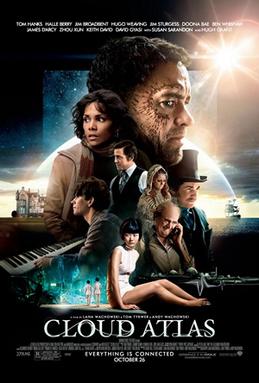
In Theaters: Cloud Atlas ****


It's kind of strange writing this blog post about Cloud Atlas weeks after seeing the movie.  Though I saw it during the opening weekend, I'm now aware that it bombed at the box office and that critical reviews were pretty mixed.  In other words, opinions about the movie have been set and I'm unlikely to change anyone's mind about seeing it.

Still, the more I think about Cloud Atlas, the more I admire it.  More importantly, the more I think about it, the more I like it.

This is, to put it mildly, an ambitious piece of work.  From the minute I saw the first trailer, I said that it was either going to be a masterpiece or a total train wreck.  I may have been off by a little -- While I'm not ready to call it a masterpiece, I will say that it works, it works very well.

Where to begin?

In Theaters: The Perks of Being a Wallflower ***


As I watched The Perks of Being a Wallflower, a fine movie with some very strong performances, I realized that I'm just not the target audience for movies like this.  You see, I'm just not one of those people who's life was defined by what happened in high school.  So, throughout the movie, I kept hoping that the story about a group of high school misfits would expand into later years -- that we'd at least get an epilogue or something.

My wish didn't come true.  The movie is entirely about high school, which wouldn't be a bad thing or even all that remarkable if it didn't take itself and its characters lives so seriously.

Friday, November 9, 2012

In Theaters: Argo ***1/2


Remember when all of you people were like "Ben Affleck sucks," and I was like "No he doesn't, he's just chosen some really bad roles."  Then, you were all like "Whatever, dude, Ben Affleck is a joke, stop trying to convince me otherwise," and I was like "Shutup, dude.  Your mom's a joke..."

I bet you all are feeling pretty silly right about now.

Argo is Affleck's third directorial effort after Gone Baby Gone and The Town.  So far, he has amassed a record that the vast majority of filmmakers in Hollywood would kill for.  And, along the way, he's become one of Hollywood's go-to directors for high-quality movies aimed at adults.  I think it's safe to say that he'll be longer remembered for his skills as a director than as an actor.  Indeed, on all counts, I'd say he has a great chance to be his generation's Clint Eastwood.

Saturday, October 27, 2012

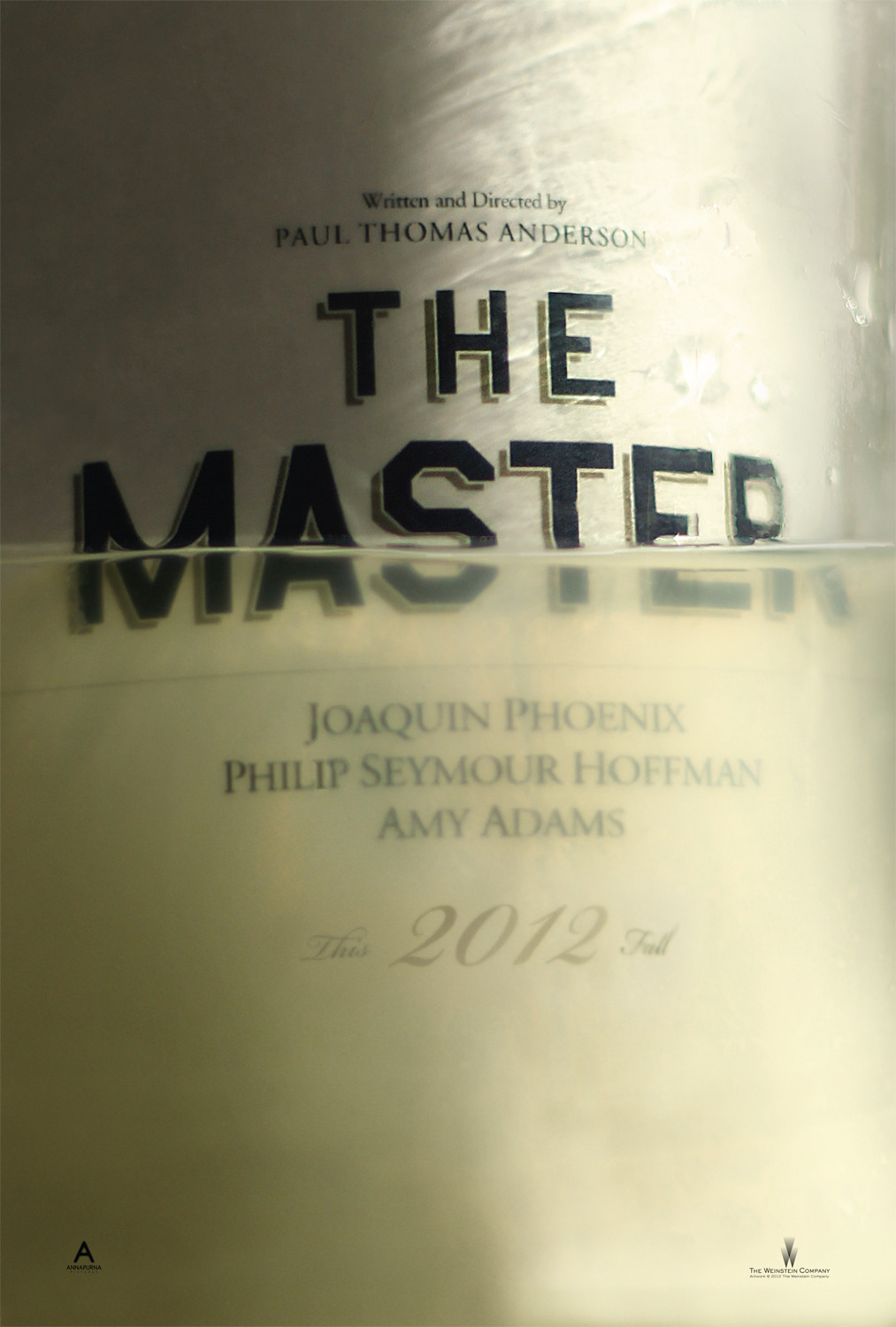
In Theaters: The Master ****


I shouldn't be writing a review of The Master just yet.  I need to see it again.

It's been a couple weeks and I still don't know what to think about it.  What I do know is that I've never seen anything like it before.  I can think of very few movies that I've found so fascinating and perplexing.  I've pondered it enough to understand the its overall meaning -- at least I think I have.  I just need see it again so I can A) confirm that my understanding fits and B) re-experience the film from the beginning with my new understanding in place.  

Who knows?  Maybe I don't get it at all.

At this point, I know enough to say that I enjoyed the film immensely and that I'd recommend to it to others.  That's why it gets four stars.

Sunday, September 30, 2012

In Theaters: Trouble with the Curve ***


Let me make one thing clear up front: I'm a pretty big Clint Eastwood apologist.  I've got a Clint Eastwood coffee-table book sitting in my living room that I look through at least once a month.  For a while, I actually had my wife considering Eastwood as a middle name for our child (don't tell me that wouldn't be awesome, because it would).

So, I have a tendency to over-like many of his movies, ignoring flaws and providing rationalizations along the way.  I do this with regard to both his acting and his directing.  That being the case, I really can't be trusted to provide an objective assessment of Clint's work (yes, I call him by his first name).

But, even so, I didn't really love Trouble with the Curve, but I liked it. Truth be told, there's not much wrong with this movie.  It's not going to win any awards, but it's a pleasant enough way to spend two hours.

Saturday, September 29, 2012

In Theaters: Looper ****


Okay, let's say you've watched the trailers and commercials for Looper.  So, you're aware that it's a shoot-em-up actioner with an odd but interesting sci-fi premise.  You know that it involves a group of hit-men assigned to kill targets transported back in time from a future wherein time travel has been invented.  And, you know that the protagonist is assigned to kill his future self.

Sorry, you don't know anything about this movie.  Not of the most interesting parts anyway.

There is a rich, detailed world created for this movie that's only hinted at in the trailers.  There are twists and wrinkles to the story that aren't even alluded to in the commercials.  Even if the movie wasn't very good -- and it is, believe me -- the studio could claim credit for outstanding marketing that managed to pull viewers in without giving everything away.

It's a triumph all-around.